Showing posts with label research. Show all posts

July 25, 2013

NEWS: 7/26 Public Celebration to Welcome the Muon g-2 Electromagnet to Fermilab

[UPDATE: The Muon g-2 Ring has arrived at Fermilab as of 4:07am Friday morning! Photo at left courtesy of Reider Hahn, as shown on Fermilab's Scribble feed.] After its long journey, the Muon g-2 electromagnet is in its last few miles of the #BigMove, and Fermilab is hosting a public celebration on Friday, July 26 to welcome the Ring's arrival. Fermilab officials released the following:
We're holding a party tomorrow to welcome the ring. If you plan to come, you should read this. Rain and thunderstorms are forecasted for tomorrow evening. The indoor portion of the muon g-2 event will occur regardless of the weather including hands-on science activities in Wilson Hall and scientists available to answer your questions (beginning at 5:30). The ring will move rain or shine and would be delayed only in the event of lightning. Check back here for updates and if you're planning to come out, bring your rain gear.
Here's a fascinating time-lapse video from Fermilab showing the July 24-25 overnight move in Illinois:


Naperville, IL Community Television, Channel 17 also featured video coverage of the Ring's arrival in nearby Lemont at http://www.nctv17.com/napervillenews17/article.php?id=2579 [Link via Fermilab]

June 18, 2013

Giant Electromagnet Starts Long Trip from Brookhaven to Fermilab

[UPDATE: Storms in the U.S. Northeast region will delay the start of the "Big Move"; details at the Chicago Tribune. The Delaware Online reports,
"Scientists will begin the move next Saturday, taking the magnet from its location on the 5,300-acre Brookhaven campus to the front gate — a distance of about 1.8 miles. The following day, they are expected to move the magnet south along the William Floyd Parkway for 6 miles to Smith Point Park on the Atlantic Ocean. From there, it will be loaded onto a barge and will proceed down the East Coast, around the tip of Florida and up the Mississippi, Illinois and Des Plaines rivers."
Over the next few weeks, you may be fortunate enough to see - but hopefully not be stuck in traffic behind - some eye-poppingly huge particle physics gear traveling down a highway near you. This week, the 50-foot diameter, 15-ton Muon g-2 ("gee minus two") electromagnet was inched out of its current location at Brookhaven National Laboratory on a custom-designed rig, starting a 3200-mile long journey over highways and sea to its new home in Chicago's western suburbs. [Video copyright Emmert International, who are handling the transport logistics of the "big move."]


You can monitor the Muon g-2's progress on this live interactive map, updated every few hours, from the Atlantic seaboard down around the tip of Florida, into the Gulf of Mexico, and finally up through Alabama and several Southern states, through St. Louis, to its final destination at Fermilab in Batavia, Illinois. Why go to such heroic efforts to relocate the Muon g-2? According to Lee Roberts of Boston University, spokesperson for the Muon g-2 experiment,
"It costs about 10 times less to move the magnet from Brookhaven to Illinois than it would to build a new one, so that's what we're going to do. It's an enormous effort from all sides, but it will be worth it."
Fermilab's website explains the details of the project, and the new research capabilities the equipment will provide:
"The muon, like its lighter sibling the electron, acts like a spinning magnet. The parameter known as "g" indicates how strong the magnet is and the rate of its gyration. The value of g is slightly larger than 2, hence the name of the experiment. This difference from 2 is caused by the presence of virtual particles that appear from the vacuum and then quickly disappear into it again....In measuring g-2 with high precision and comparing its value to the theoretical prediction, physicists will discover whether the experiment agrees with theory. Any deviation would point to as yet undiscovered subatomic particles that exist in nature."
More images and videos of the Muon g-2 Project and the "Big Move" can be found at Fermilab

April 23, 2013

Radioactive Listeria Bacteria: Promising New Weapon Against Pancreatic Cancer

Most of us recognize Listeria as one of the bacteria found in soil, raw and undercooked foods, and unpasteurized dairy products, which can cause serious illness including a high risk of miscarriage in pregnancy. However, researchers at Yeshiva University's Albert Einstein College of Medicine have discovered this pathogen can be tagged with a radioisotope and drafted to fight a dreaded disease: metastatic cancer of the pancreas.

Dr. Claudia Gravekamp and Dr. Ekaterina Dadachova, co-senior authors of the study and professors at Albert Einstein, have developed a method of using a weakened strain of Listeria monocytogenes tagged with a short half-life rhenium isotope to selectively infect tumor cells (Abstract from Proceedings of the National Academy of Sciences). According to Dr. Gravekamp, in a press release from the university,
"We're encouraged that we've been able to achieve a 90 percent reduction in metastases in our first round of experiments...[w]ith further improvements, our approach has the potential to start a new era in the treatment of metastatic pancreatic cancer."
As Dr. Dadachova also explains in the Albert Einstein College of Medicine press release,
"We chose rhenium because it emits beta particles, which are very effective in treating cancer...also, rhenium has a half-life of 17 hours, so it is cleared from the body relatively quickly, minimizing damage to healthy tissue."
More:

March 26, 2013

Chernobyl Database: A New, Useful Research Tool

While having much of the Internet at one's disposal through search engines is a wonderful thing - especially when you know what you're looking for - specialized blogs like the new Chernobyl Database (launched February 2013) also serve a vital purpose: they can help point you in the direction of new research studies and findings you may have been unaware of.

Chernobyl Database, which I believe is based in Japan, focuses fairly narrowly on posting papers studying the effects of radiation and radioactive contamination on the environment and health, but it also ventures deeply by including links to research going back several decades. Entries are primarily in English, with separate categories for articles published in Japanese and Russian. I think you'll find it a valuable resource.

October 24, 2012

Self-Powered Sensors Enable Monitoring Reactor Fuel Rod Status During Total Power Failures

Researchers at Penn State and Idaho National Laboratory have announced an important breakthrough in sensor technology that promises to improve operating safety and control of reactors in the event of total power failure:
Penn State researchers [have] teamed with the Idaho National Laboratory to create a self-powered sensor capable of harnessing heat from nuclear reactors' harsh operating environments to transmit data without electronic networks. The team [are presenting] their research at the Acoustical Society of America's...164th Meeting, October 22-26, 2012, in Kansas City, Missouri.

"Thermoacoustics exploits the interaction between heat and sound waves," explains Randall A. Ali, a graduate student studying acoustics at Penn State. "Thermoacoustic sensors can operate without moving parts and don't require external power if a heat source, such as fuel in a nuclear reactor, is available."
In the unlikely (but not unprecedented) event of complete power failure, as occurred when backup generators at Fukushima were flooded with seawater following the earthquake and tsunami of 11 March 2011, these self-powered sensors would allow plant operators to continue monitoring conditions within the reactor in the critical first minutes and hours of an emergency.

September 18, 2012

Argonne Energy Showcase: The Short Video

Some of the remarkable scientific sights and sounds RadioActive! The Nuclear Blog captured at this weekend's Argonne National Laboratory Energy Showcase 2012.

Video Highlights from Argonne National Lab's Energy Showcase 2012

Didn't get a chance to visit Argonne National Laboratory's 2012 Energy Showcase in the Chicago suburbs this past September 15th? Don't worry: we're very happy to share our video and photo highlights from this rare opportunity to peek inside the birthplace of modern nuclear science, and see first-hand some of the amazing research being done in America's heartland.

According to an on-site event organizer, this year's open house was the first one held in five years, after tighter security restrictions post-9/11 put National Laboratory open houses on hold. This year's Energy Showcase was also the first to require visitors to pre-register online. While past events had as many as 20,000 visitors each, Energy Showcase 2012 hosted a more modest registered attendance of approximately 2,000* - not necessarily a downside if you were seeking a good, close look at the dozens of fascinating exhibits on hand. [*According to another person I spoke to later, the registration attendance was capped at 10,000, so I may have misheard the original attendance estimate. If any readers out there have more solid attendance stats, please let us know in the comments! - LR]

First, let's stop in at the Physics building to have a look at the Gammasphere, the world's most powerful spectrometer for nuclear structure research. If the Gammasphere looks familiar, you may remember that the device had a 'guest starring role' in the 2003 feature film "Hulk," as the contraption that triggered Bruce Banner's verdant transformation - back then, it was physically located at Lawrence Berkeley National Laboratory. Read more at http://www.phy.anl.gov/gammasphere/index.html


Next, let's take a short drive south to the nearby Advanced Photon Source complex, a facility which provides the brightest x-ray beams in the Western Hemisphere to more than 5,000 scientists from around the United States and the world. Here's a panned view from the APS observation gallery, as a researcher gives a basic explanation of its workings in the final 30 seconds or so of the video. In person, the building and equipment are remarkably large; what you see here on the video is only a tiny fraction of the APS accelerator "ring." More at http://aps.anl.gov/About/APS_Overview/


Here is a live demonstration of a technique called "acoustic levitation" that uses high-frequency (~22kHz) sound waves to suspend small objects like liquid droplets, plastic spheres, and popcorn in mid-air. Bystanders could manipulate and rearrange the plastic beads within the sound column using a metal spoon, creating intriguing patterns. As you can see from the video, the column behaves as though the beads are 'magnetically' attracted along an invisible vertical line running between the upper and lower sound generators. The demonstrators explain that the beads are spaced at wavelength node intervals of about one-third inch, allowing visualization of the standing wave. More at http://www.anl.gov/articles/no-magic-show-real-world-levitation-inspire-better-pharmaceuticals


Down the hall, we stopped by to see an X-ray diffraction demonstration, which provides a simulation of how the APS' powerful X-ray beam can reveal the before-unseen inner structures of nanoparticles, proteins, crystalline structures, organic molecules, and many other materials. More at http://aps.anl.gov/


In part 2 of our look inside Argonne National Laboratory, we'll visit ANL's Nuclear Museum, home of many historical treasures from the dawn of the Atomic Age.

June 11, 2012

"Lessons Learned from 'Lessons Learned': The Evolution of Nuclear Power Safety After Accidents and Near-Accidents" (AAAS monograph, 2012)

Continuing our theme of our evolving understanding of nuclear power safety, I'd like to highlight an excellent - and timely - paper just released by the American Academy of Arts and Sciences, "Lessons Learned from 'Lessons Learned': The Evolution of Nuclear Power Safety after Accidents and Near-Accidents," by Edward D. Blandford and Michael M. May. From the preface:
"As countries struggle to meet the electricity demands of their growing populations while also reducing their carbon footprints, many have turned to nuclear energy. The U.S. nuclear energy program may not increase significantly in the coming decades, but other countries, including many developing countries, have plans for rapid expansion. Even after the recent accident at the Fukushima Daiichi Nuclear Power Plant in Japan, the global trend toward expansion of nuclear energy has continued.

While serious accidents like Fukushima, Three Mile Island, and Chernobyl can provide invaluable lessons, the nuclear industry, nuclear regulators, and the research community must study minor incidents and near-accidents as well. These experiences often reveal not only how to decrease the likelihood that the same mistakes will occur, but also how to avoid larger accidents that may be foreshadowed in earlier, smaller incidents.

In this paper, Edward Blandford and Michael May enumerate the lessons from nuclear accidents and incidents, asking whether the nuclear energy community has indeed learned from those lessons. The authors argue that stakeholders must commit to ongoing improvement of their protocols and standards. Each nuclear incident—no matter its size—underlines the importance of pursuing high standards of safety, security, and proliferation resistance."
One standout key finding in "Lessons Learned..." is on page 23, in Table 1, "Main Sources of Electricity in the World and Their Morbidity and Greenhouse Gas Emissions Per Unit of Electricity Produced." The authors find that while nuclear energy is the fourth most prevalent form of electricity generation worldwide (at 14% of global usage), it is associated with the lowest number of deaths per terawatt hour (0.04). The least common form of generation, wind power (< 1% of global usage), somewhat surprisingly has a morbidity rate of 0.15 deaths per terawatt hour, but I suspect many of these might be a result of accidents involving installation or maintenance of the wind turbines, rather than the operating process itself.

If you're pressed for time, the paper's executive summary provides an informative primer on its conclusions and policy recommendations for the industry. The paper is available as a free PDF download as part of the AAAS' Occasional Papers series at http://www.amacad.org/publications/lessonsLearned.aspx, or as hard copy for a nominal fee from the AAAS.

June 06, 2012

'Meltdowns' Making Safer Reactors: CEA's PLINIUS Platform and Finland's VTT

[See also "Alexander Borovoi: Chernobyl Explorer"]

The mention of the word meltdown conjures our deepest fears about nuclear power: an out-of-control reactor core collapsing into molten radioactive "lava" that consumes metal, reactor housings, concrete foundations - even, as cautionary tales warn, the ground beneath the reactor itself. While the "China Syndrome" is thankfully just a frightening fiction, complete or partial meltdowns have occurred in several severe accidents, notably Three Mile Island, Chernobyl, and most recently at three of Fukushima Daiichi's reactors. Recent European studies have even suggested that the likelihood of a severe accident is much higher than previously thought:
"Based on the operating hours of all civil nuclear reactors and the number of nuclear meltdowns that have occurred, scientists at the Max Planck Institute for Chemistry in Mainz and the Cyprus Institute have calculated that such events may occur once every 10 to 20 years (based on the current number of reactors) - some 200 times more often than estimated in the past."
Clearly, one important goal must be designing reactors that resist losing structural integrity in the event of an accident or meltdown, that can reliably withstand molten corium's extreme temperatures without breaching containment. Our scientific understanding has been limited in the past by the difficulty of studying meltdowns during actual emergencies, and in recreating their volcanic conditions in a controlled environment. This is one of the reasons why the innovative prototypic core melt research being performed at facilities like CEA's PLINIUS Platform, and the VTT Technical Research Centre of Finland, is crucial in developing new building materials for safer nuclear plants, as well as learning to prevent meltdowns and minimizing environmental exposure should one occur.

PLINIUS is an experimental platform for the study of severe accidents using prototypic corium, laboratory-created high-temperature molten mixtures containing depleted uranium oxides that recreate the "melt" of theoretical "meltdowns".

Its four facilities study different aspects of corium formation and behavior: VULCANO is a "50-100 kg corium melting facility," where oxides and metals are combined in a rotating cylindrical furnace and melted using induction heating, transferred plasma arc technology, or through exothermic redox reactions ("uranium thermite"). The "melt" is then poured into a test section of concrete, ceramic, or other material to study flow patterns, chemistry, and resulting material structure. COLIMA is a smaller, enclosed induction-heated unit that allows study of corium/gas interaction and aerosol formation, while KROTOS is used to observe and measure the behavior of small (~5kg) quantities of corium when dropped into water. As PLINIUS' site understatedly describes, "energetic steam explosions can be triggered and studied":
Heat transfer between the hot molten core with the colder volatile water [in KROTOS] is so intense and rapid that the timescale for heat transfer is shorter than the timescale for pressure relief, leading to the formation of a shock wave. This shock wave is intensified as a result of further mixing and energy transfer as it travels through the mixture.
The smallest of PLINIUS' facilities, VITI, (image above is a tiny molten corium droplet in the VITI crucible) specializes in tests using corium samples of less than 100 grams, mainly used for thermophysical/thermochemical property analysis, or controlled-atmosphere material interaction tests.

While Finland's Technical Research Center (VTT) conducts international applied industrial research and analysis in a variety of fields, its nuclear reactor safety program has also developed advanced simulated reactor environmental modeling (APROS) and reactor aging studies, as well as joint corium melt research with CEA's PLINIUS. Ongoing research into the science behind meltdowns, such as the work being done at PLINIUS and VTT, will help create safer, more accident-proof nuclear reactors and containment structures for our world's endlessly growing need for cleaner energy.

CEA PLINUS Platform Research Links: VTT Research Links:

May 24, 2012

Nevada's Historic BREN Atomic Test Tower Demolished

[Image and YouTube video from the NNSA. Thanks to James Stover (tweeting at @JamesStoverAPR) for the story!]

Yesterday, in the Nevada desert, demolition crews from New York and Maryland felled a legendary piece of America's atomic history.

At 1,527 feet tall, the former Nevada Test Site's BREN tower was the "tallest free-standing structure west of the Mississippi River," and also the "tallest structure of its kind ever demolished," according to the National Nuclear Safety Administration. Originally built in 1962 in Yucca Flats, from fifty-one 30-foot sections of steel and two and a half miles of steel cable, the tower was moved to its latest location in Jackass Flats in 1966 after the Nuclear Test Ban Treaty banned open-air nuclear testing.
From CNN: The tower stood taller than the Empire State Building (1,454 feet) and the Eiffel Tower (1,063 feet). It was also taller than the iconic Stratosphere (1,148 feet) on the Las Vegas strip...[T]he BREN Tower took its name from the nuclear radiation experiment for which it was built: Bare Reactor Experiment - Nevada. BREN Tower was designed to provide a way for scientists to accurately estimate radiation doses received by survivors of the atomic bombs detonated over the Japanese cities of Hiroshima and Nagasaki during World War II. The tower stood 1,527 feet tall because that was the height at which "Little Boy," the first atomic bomb used in warfare, was detonated over Hiroshima on August 6, 1945.
At one time, a mock Japanese village was built near the tower's base to give researchers better modeling of the effects of a nuclear explosion on inhabited areas. Officials from the NNSA said the tower, which stopped being used in 1999, was too costly to maintain and restore, and posed a hazard to passing aircraft.

April 06, 2006

Cerenkov Radiation

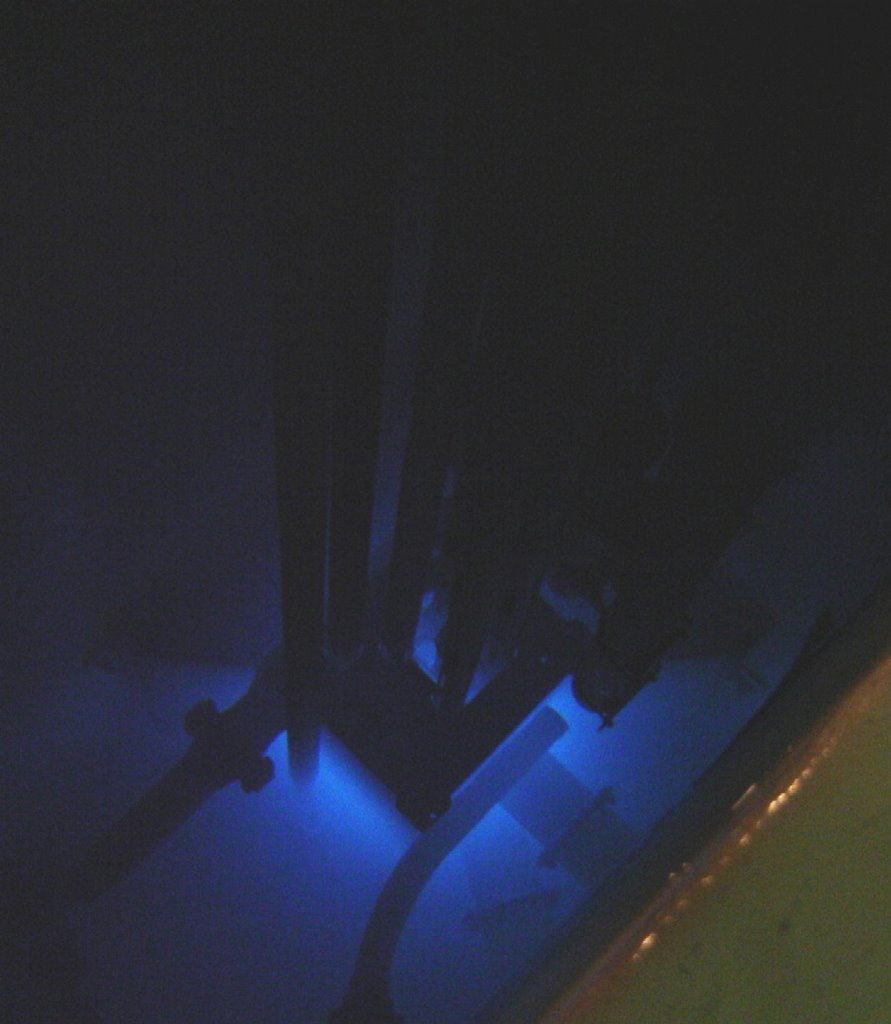
A RadioActive! reader sent us this fascinating image of blue Cerenkov radiation from Ohio State University's research reactor:
"...attached is a photo...of our research reactor at OSU, which I took from the pool-top during operation at about 50 kW (thermal). The blue Cerenkov glow caused by photoelectrons, Compton electrons, and beta particles is evident here, but [in my opinion] is much prettier at our licensed power of 500 kW!
Regards,
Carl Willis"
Click on the image at left to expand to a full-size [890 x 1024] detailed image.

March 10, 2006

Upcoming World Conference in Belarus on "Chernobyl After 20 Years"

From the Bahrain News Agency:
Minsk, March. 10, (BNA)

A world conference will be held on April 19, in the capital city of Belarus, under the theme of "Chernobyl after 20 years: Urbanization strategy and Sustainable development of the Unfortunate Area." The conference which will mark the 20th anniversary of the disaster will be attended by representatives of 50 countries and 16 international organizations.

The Russian News Agency, Itar Tass, said today invitations for the conference was sent by Belarus President to Director of the International Atomic Energy Agency (IAEA), the World Health Organization (WHO) and UN Development Organization (UNDO). During the conference, Belarus, the most hit country, Russia and Ukraine will present reports on the efforts they had made to alleviate the disaster's effects.

May 12, 2004

Will A.L.I.C.E. "Swallow Up The Earth"?

[UPDATE: Needless to say, A.L.I.C.E did not, in fact, swallow up the Earth. - LR]

Both the fact and fiction about CERN's soon-to-be-completed Large Ion Collider, or "ALICE," seem as strange as anything Lewis Carroll put to print in a chemical-indiced haze; some are concerned that in theory, our planet may end up literally "falling down the rabbithole."

The "Wonderland" metaphor extends to CERN's own press on the project, where Carroll's young protagonist appears frequently on the site's pages. From the CERN Project site:
The ALICE Collaboration is building a dedicated heavy-ion detector to exploit the unique physics potential of nucleus-nucleus interactions at LHC energies. Our aim is to study the physics of strongly interacting matter at extreme energy densities, where the formation of a new phase of matter, the quark-gluon plasma, is expected.

The existence of such a phase and its properties are key issues in QCD for the understanding of confinement and of chiral-symmetry restoration. For this purpose, we intend to carry out a comprehensive study of the hadrons, electrons, muons and photons produced in the collision of heavy nuclei. Alice will also study proton-proton collisions both as a comparison with lead-lead collisions in physics areas where Alice is competitive with other LHC experiments
A lone voice in the wilderness, James Blodgett of the Albany, NY-based Risk Evaluation Forum, is afraid that ALICE may potentially have a rather nontrivial "Doomsday" flaw:
There is a risk that a physics experiment scheduled for 2007 may destroy the earth.

Recent developments in string theory suggest that mini-black holes may be created in the next generation of particle colliders. The possibility that the upcoming Large Ion Collider at CERN might produce mini-black holes is predicted by several articles cited in our "references" section. Go there. Their idea is that gravity might be much stronger than expected (We calculate up to 10^33 times stronger) at very small scales if the inverse square law becomes an inverse hypercube law at small scales due to extra dimensions.

Extra dimensions at sub-atomic scales are a strong prediction of string theory. String theory is considered fairly plausible by many physicists. The authors who predict mini-black hole production expect these holes to evaporate via Hawking radiation. But Hawking radiation has never been seen nor tested. It is based on a quantum theory which is widely accepted, but also widely regarded as strange. If mini-black holes are created and do not evaporate they could implode the earth.
Understandbly, both sides of the argument qualify as arcane topics - even if the potential consequences could be...how shall I say...spectacular. Very Strange stuff, indeed. J.R. Labbe of the Star-Telegram [registration required to access online articles] says,
Founded 50 years ago, CERN is (in English) the European Organization for Nuclear Research, the world's largest particle physics center. This is where really, really smart people study what matter is made of and what holds it together. To do that, you need a really, really huge particle accelerator.

And that is what has Blodgett worried. Because the CERN scientists are getting ready to throw the switch on one honking big collider.

"The Large Hadron Collider (LHC) [a.k.a. the ALICE Project] is a particle accelerator which will probe deeper into matter than ever before," says the CERN Web site. "Due to switch on in 2007, it will ultimately collide beams of protons at an energy of 14 TeV. Beams of lead nuclei will be also accelerated, smashing together with a collision energy of 1150 TeV.

"A TeV is a unit of energy used in particle physics. 1 TeV is about the energy of motion of a flying mosquito. What makes the LHC so extraordinary is that it squeezes energy into a space about a million million times smaller than a mosquito."
More discussion on "ALICE Swallowing the Earth"?

FuturePundit
Star-Telegram: "If The Earth Disappears, He Was Right"
Blodgett's own posting on SciScoop
A related Black Holes Forum message on www.astronomy.net
CERN Tutorial: "What Is Quark Matter?"