

For even more images, visit Argonne National Lab's official Flickr photostream.

At one time, a mock Japanese village was built near the tower's base to give researchers better modeling of the effects of a nuclear explosion on inhabited areas. Officials from the NNSA said the tower, which stopped being used in 1999, was too costly to maintain and restore, and posed a hazard to passing aircraft.From CNN: The tower stood taller than the Empire State Building (1,454 feet) and the Eiffel Tower (1,063 feet). It was also taller than the iconic Stratosphere (1,148 feet) on the Las Vegas strip...[T]he BREN Tower took its name from the nuclear radiation experiment for which it was built: Bare Reactor Experiment - Nevada. BREN Tower was designed to provide a way for scientists to accurately estimate radiation doses received by survivors of the atomic bombs detonated over the Japanese cities of Hiroshima and Nagasaki during World War II. The tower stood 1,527 feet tall because that was the height at which "Little Boy," the first atomic bomb used in warfare, was detonated over Hiroshima on August 6, 1945.
 [Originally posted 4/26/2004]
 UPDATED 4/26/2006:
Controversy over the "Kidd of Speed" website [NeilGaiman.com]
Ukraine Remembers Chernobyl Nuclear Accident [AP, CBS2 Chicago]
An extensive gallery of Chernobyl Images from the INSP (http://insp.pnl.gov/-library-uk_ch_1-1.htm)
BBC: Chernobyl 20 Years On
The German nuclear-safety agency GRS [Gesellschaft für Anlagen und Reaktorsicherheit, mbH] has a well-illustrated, informative 179-page free online technical report called "The Accident and the Safety of RBMK Reactors" [large PDF file, 5Mb].
If you enjoy government reports and "blue books," visit the World Nuclear Association's Chernobyl page, which includes links to UNSCEAR [United Nations Scientific Committee on the Effects of Atomic Radiation, which published several comprehensive reports on the Chernobyl disaster - many which are available here as free PDF downloads.
Watch This: Chernobyl.co.uk, a UK site which features a link to the BBC's recent 30-minute program [streaming RealPlayer video] on Chernobyl, featuring a look at the history of nuclear power in the former Soviet Union as well as a look inside Ukraine's Exclusion Zone towns. Highly recommended: this program illustrates that the deteriorating reactor site is still an issue of pressing concern through Europe, while it has been all but overshadowed here in the U.S.
Watch This: though the bulk of Chernobyl news coverage occurred before the age of streaming video, the post-date digitized BBC retrospective of the Chernobyl disaster [RealPlayer required] is a wistfully immediate - if lo-res - look back at those fateful days in April 1986.
Ukrainian biker gal (and young scientist) Elena is the Kidd [sic] of Speed: her wildly popular site, Ghost Town, features dozens of startling photos and rueful, blustering commentary from her motorcycle tour through the post-apocalyptic Exclusion Zone in Pripyat': part National Geographic expedition, part Jackass-meets-Evel Knievel. Strange thing is, I'd probably do it too, given the opportunity and a lead X-ray apron - but I'd prefer an enclosed vehicle, like a Bradley.
Got Euskadi? The Basque Website of Pripyat.
Have Paris, Rome, and the Caribbean lost their appeal? Been there, done that? How about a guided group tour through Chernobyl? I don't know if it's a legitimate enterprise, but you can apparently book a tour through the Exclusion Zone via Ukrainian Web Chyornobyl' Tour. You get complimentary disposable outerwear and shoes, and a souvenir computerized dosimeter printout that certifies how much radiation you absorbed during your visit.
The Jet Propulsion Laboratory's Pioneer Robot pages, with photos and diagrams of the Red Zone Robotics radiation-hardened explorer robot that will be used to excavate and explore the hot ruin inside the Sarcophagus.
A recent Kazakhstan Kazinform press release from March, 2004, warning that trouble at the Chernobyl Sarcophagus could be imminent.
From a nation that is also highly dependent on nuclear energy, but has thankfully suffered neither a Chernobyl nor a Three Mile Island type incident - the Canadian Nuclear Association's report on Chernobyl.
USGS satellite photos showing changes in the Chernobyl region from 1986 to 1992.
An August, 1986 EPA Bulletin on short-term American response to the Chernobyl disaster.
Gla55pak.com has compiled some unusual Chernobyl images here, and proclaims "I have a sick curiosity - more of an impulse - to be there that night and watch the thing light up. I would gladly take a good dose just to have seen it. It is, after all, like an immense train wreck that I just can't help but see." Also: link to Disenchanted.com's take on the Chernobyl and TMI incidents, called "Fear's just bad for business".
A high-resolution satellite image of the Chernobyl region from the Jet Propulsion Laboratory, suitable for desktop backgrounds.
Some of the best photos of the site I have seen are on the INSP's [International Nuclear Safety Program] Digital Library Website, where you can view over 800 color and black-and-white images, including the one at the top of this post.

01:24:00If this photo is genuine, then it would be the first time I've been able to track down an image of the reactor in the earliest stages of the accident. I have not yet found an image of this type anywhere in Chernobyl literature, either on video, in books or and other source. Where did this come from, considering that the former Soviet Union did not inform the outside world of the explosion until days later? Was there a camera trained on the reactor? Did the image come from a flight over the reactor later than the timestamp indicates?
Recording of the shift supervisor: "Strong impacts, the shutdown systems stop before reaching the lower end position ..." Reactor excursion with more than 100 times of the nominal power. Explosion and destruction of the reactor core. The upper plate of the reactor is hurled up, all pressure tubes break off. Core material and burninggraphite parts are ejected. The reactor is burning, further fires start in the surrounding. Massive release of radioactive fission products.
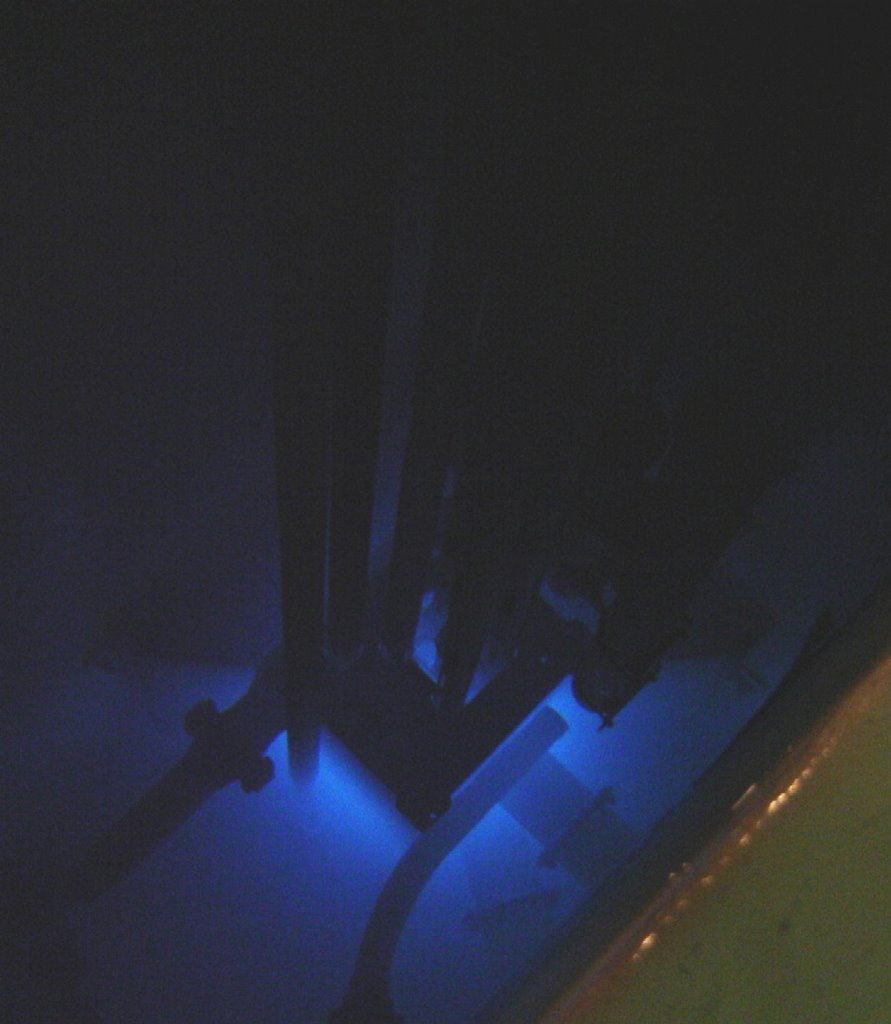 A RadioActive! reader sent us this fascinating image of blue Cerenkov radiation from Ohio State University's research reactor:
"...attached is a photo...of our research reactor at OSU, which I took from the pool-top during operation at about 50 kW (thermal). The blue Cerenkov glow caused by photoelectrons, Compton electrons, and beta particles is evident here, but [in my opinion] is much prettier at our licensed power of 500 kW!Click on the image at left to expand to a full-size [890 x 1024] detailed image.
Regards,
Carl Willis"

"...I've been reading your Radioactive blog with interest, and I wanted to call to your attention a series that we recently started running on our website. It is called "Chernobyl: 20 Years 20 Lives" and it is a series of eyewitness accounts in words and interviews of people whose lives continue to be affected by the Chernobyl nuclear disaster...."Thank you for your message, Kathy - I'm very happy to pass on the word, and thank you for all the good work your organization provides to help those affected by the disaster.
Chernobyl – Twenty Years, Twenty Lives is EarthVision's photo journalistic journey through the countries of the Ukraine, Belarus, Russia, Latvia, Sweden, France, and UK. It follows twenty people in their daily lives nowadays and reflects on how they changed after the events of April 1986. The goal of the project is to learn from the history and look at the accident from the present perspective at different levels, both locally and globally. Almost 20 years after the Chernobyl disaster, controversy continues about the true effects of the disaster. Chernobyl Children's Project International believes that the story of Chernobyl can be best told through the eyes of the variety of people who have been affected by the disaster.
...
A photo exhibition with the twenty life stories will tour the world beginning at April 2006. EarthVision is currently seeking exhibition hosts. You can reach EarthVision and learn more about the project at 20lives.info.

01:24:00If this photo is genuine, then it would be the first time I've been able to track down an image of the reactor in the earliest stages of the accident. I have not yet found an image of this type anywhere in Chernobyl literature, either on video, in books or and other source. Where did this come from, considering that the former Soviet Union did not inform the outside world of the explosion until days later? Was there a camera trained on the reactor? Did the image come from a flight over the reactor later than the timestamp indicates?
Recording of the shift supervisor: "Strong impacts, the shutdown systems stop before reaching the lower end position ..." Reactor excursion with more than 100 times of the nominal power. Explosion and destruction of the reactor core. The upper plate of the reactor is hurled up, all pressure tubes break off. Core material and burninggraphite parts are ejected. The reactor is burning, further fires start in the surrounding. Massive release of radioactive fission products.


