Showing posts with label accidents. Show all posts

April 08, 2013

"Exposure: Radiation Victims Speak Out" Web Series Reveals Personal Struggles, Triumphs

Over 20 years ago, the Hiroshima newspaper Chugoku Shimbun sent a team of reporters to 15 nations around the world to gather personal accounts of people affected by radiation - from reactor accidents, accidental contamination, to nuclear weapons manufacturing and testing. The interviews were initially published as a series of eight newspaper features titled "Sekai no Hibakusha," or "Hibakusha (figuratively, "atomic bomb survivors") Around the World." This monumental series won a Japan Newspaper Publishers and Editors Association award in 1990, and was subsequently published in book form the following year. Executive Director of the Chugoku Shimbun Yukio Ogata explains,
"Largely as a result of the articles' success in bringing the public's attention to the dangers of radiation, a number of victims of radioactive contamination from areas as far-flung as Chernobyl and Bikini Atoll were able to participate in the world convention held in Hiroshima by the International Physicians for the Prevention of Nuclear War in October 1989...[T]he convention heard details concerning the damage caused by nuclear testing in Kazakhstan, which until then had been shrouded in secrecy. In turn, this disclosure of widespread destruction of the environment prompted the Chugoku Shimbun to instigate the first-ever investigation of the testing area.

At the same time, the articles served to emphasize the role that Japan could play to help radiation victims around the world. The fact that the articles have prompted the exchange of information concerning the treatment of radiation victims in Japan to help those in a similar plight in other countries is a great source of satisfaction to us at the Chugoku Shimbun. We hope that, in the future, Japan will become known as an information center for radiation victims and the treatment of their illnesses."
In March 2013, the Hiroshima Peace Media Center re-released the entire series of 134 interviews free online as "EXPOSURE: Victims of Radiation Speak Out". From the English-language introduction by Dr. Robert Jay Lifton, Director of the Center on Violence and Human Survival at the CUNY John Jay College of Criminal Justice notes,
"There is compelling appropriateness in the project's being undertaken by concerned journalists from Hiroshima. From the time the bomb was dropped, the Chugoku Shimbun, as Hiroshima's leading newspaper, has been a prime source of information about the experiences and feelings of the people of that city over subsequent decades. Its editors and writers have taken on what I call a 'survivor mission' on behalf of the city's victims, a commitment to transforming the fear, conflict, and pain of the survivors into an active exploratory enterprise of profound significance.

Their contribution goes even beyond their descriptions of the human effects of radiation. In the way they have approached their study, they have demonstrated what I call a species mentality, a commitment that transcends immediate group or nationality and extends to all of humankind. They evoke in us a sense of shared fate, of universal susceptibility to a technology that knows no boundaries, geographical or temporal. We are all in this together, as potential victims and potential perpetrators as well.
Among the regions and incidents covered in these interviews are Chernobyl, the 1987 Goiânia Accident in Brazil, contamination from the Cold War weapons program at Semipalatinsk, Kazakhstan, and the Hanford Nuclear Reservation site in Washington State.

[Image courtesy Hiroshima Peace Media Center: "The mushroom cloud as seen from Kure, approximately 18 kilometers southeast of Hiroshima. This photo was taken by Masami Oki about 40 minutes after the bomb exploded."]

More:

March 26, 2013

Chernobyl Database: A New, Useful Research Tool

While having much of the Internet at one's disposal through search engines is a wonderful thing - especially when you know what you're looking for - specialized blogs like the new Chernobyl Database (launched February 2013) also serve a vital purpose: they can help point you in the direction of new research studies and findings you may have been unaware of.

Chernobyl Database, which I believe is based in Japan, focuses fairly narrowly on posting papers studying the effects of radiation and radioactive contamination on the environment and health, but it also ventures deeply by including links to research going back several decades. Entries are primarily in English, with separate categories for articles published in Japanese and Russian. I think you'll find it a valuable resource.

November 30, 2012

Chernobyl's New Safe Confinement Rises: The First Stage

After nearly two decades of administrative, political, and financial setbacks, major progress is being made now at the New Safe Confinement. Having been previously called "Ukritye" and the "Shelter Implementation Plan" over the years, the secure NSC outer shell being built over the decaying Chernobyl Sarcophagus will allow Reactor 4 to finally be safely dismantled with greatly reduced risk to the environment.

In the clip below, Vince Novak, the EBRD [European Bank for Reconstruction and Development]'s Director of Nuclear Safety discusses the construction progress and the NSC's benefits.


This video (:35) shows a time-lapse version of the first NSC section's raising.

November 16, 2012

New Mitsubishi Videocamera Can "See" Radioactivity

Mitubishi Heavy Industries, Ltd. of Japan announced it will begin marketing early next year the Astrocam 7000 HS, a new type of video camera that can show a superimposed display of radioactivity on its wide-angle 180-degree image, allowing cleanup crews and emergency responders to see "hot spots" in real time. The Asahi Shimbun reports,
"The portable camera, which will apply technology jointly developed with the Japan Aerospace Exploration Agency (JAXA), is designed to allow for more efficient clean-up of radioactive contamination, an issue of great concern in Japan because of the nuclear disaster last year. The camera will use technology now in place on observation equipment aboard the ASTRO-H X-ray astronomy satellite operated by JAXA.

Tadayuki Takahashi, a professor of space physics at JAXA and project manager of the ASTRO-X, said, "The camera can measure radiation in high places, such as on roofs, and will lead to more efficient decontamination of radiation." Using two types of semiconductor sensors, the direction and strength of gamma rays emitted by radioactive materials such as cesium are measured and brought to light as a superimposed image on the visible landscape."
Mitsubishi this week also announced another breakthrough in nuclear cleanup technology, an armored seat that would reduce heavy equipment operators' exposure to radiation by half, and theoretically allow workers to remain twice as long in hazardous areas before receiving maximum permitted radiation doses:
The seat material, including body armor parts (shoulders, arms, chest/abdominal area, thighs, neck), consists mainly of tungsten sheet, which offers excellent radiation shielding capability. Although the seat weighs a considerable 130 kilograms (kg), individual parts weigh less than 20kg and most of their weight is integrally supported by the seat, so the burden on the operator is minimal.

In addition, the operator can put on and remove the armor-like parts easily by opening/closing the front like a vest...these features provide a high rate of radiation shielding while simultaneously minimizing fatigue during continuous work and inconvenience to machine operation from wearing such shielding.
Here, Mitsubishi Heavy Industries demonstrates the Astrocam and explains its technology in this one-hour press conference video (in Japanese, no subtitles).


[Image of demonstration camera view courtesy of Asahi Shimbun Online] More on the Mitsubishi Astrocam 7000HS camera:

September 06, 2012

Pentagon Releases Map of Estimated Radiation Doses for Americans in Japan During Peak of Fukushima Crisis

The Pentagon has released data showing radiation dosage estimates for the thousands of American nationals and military personnel in Japan at the time of the 2011 earthquake and tsunami and subsequent nuclear crisis at Fukushima. Named Operation Tomodachi, the registry seeks to "[provide] interested individuals with location-based radiation dose estimates for adults and children for the period of greatest potential exposure, from March 12, 2011 through May 11, 2011." According to the September 5th news report in Reuters,
"[T]he highest rate of adult exposure [was] at Camp Sendai, just north of Fukushima, where the estimated adult dose of whole body radiation was 0.12 rem and 1.20 for the thyroid - the organ most affected by radiation. By comparison, a full-body CAT scan yields a whole body exposure of 5.0 rem. Those American personnel who were stationed at Camp Sendai who check the website will see a message saying: 'Your whole-body and thyroid radiation dose estimates are well below levels associated with adverse medical conditions.'"
The Google API-based map [accessible here], which shows selected measurement areas with links to dosage estimate reports, is expected to be completed by the end of 2012, and will also incorporate dosage estimates and data for about 8,000 individuals who had direct radiation measurements taken.

[Image screencapture from Operation Tomodachi website, 09/06/12.]

September 05, 2012

Memorial Mass for Victims of the Goiânia Accident, 25 Years On

For our readers in Brasil, on 13 September there will be a 25th Memorial Mass commemorating the victims of the 1987 Goiânia accident held at the Igreja Nossa Senhora de Gloria, Jardim Meriti, São João de Meriti, Rio de Janeiro (via MESPE.br).

For more background information on the Goiânia accident that claimed the lives of at least 4 people, sickened dozens with radiation illness, and caused widespread contamination (INES 5) throughout several districts surrounding the accident epicenter, see our April 30, 2012 post: http://corium.blogspot.com/2012/04/radioactive-casefiles-goiania-accident.html

[Read the MESPE.br post in its original Portuguese.]

August 06, 2012

"Inside Chernobyl (2012)": A Documentary by Adrian Musto

Much has been said here and elsewhere on the longstanding tragedy of Chernobyl, so I'm always pleasantly surprised to find a fresh look at the topic. Today I discovered a documentary by Adrian Musto, a photographer and filmmaker who also posts under the nom de Web Arkitekture. What's he's created here "on no budget" (in his words) using footage from a recent visit to Ukraine and Pripyat, is remarkable. Beginning with some archival videoclips from the first days of the 1986 accident, the film captures the haunting air of present-day Pripyat, the soon-to-be "New Safe Confined" Sarcophagus, interviews with residents, and some on-the-spot radiation meter readings of objects and structures. I'm sure you'll find "Inside Chernobyl" fascinating. [Note: some of the images may be disturbing to sensitive viewers.]


Musto's photos from Chernobyl, viewable in a gallery on his website, are also stunning. You can listen to some of his Chernobyl trip backstory at Deep Inside Podcast from July 10, 2011, which features very nice atmospheric IDM music from Kiev-based producer Queensway.

June 11, 2012

"Lessons Learned from 'Lessons Learned': The Evolution of Nuclear Power Safety After Accidents and Near-Accidents" (AAAS monograph, 2012)

Continuing our theme of our evolving understanding of nuclear power safety, I'd like to highlight an excellent - and timely - paper just released by the American Academy of Arts and Sciences, "Lessons Learned from 'Lessons Learned': The Evolution of Nuclear Power Safety after Accidents and Near-Accidents," by Edward D. Blandford and Michael M. May. From the preface:
"As countries struggle to meet the electricity demands of their growing populations while also reducing their carbon footprints, many have turned to nuclear energy. The U.S. nuclear energy program may not increase significantly in the coming decades, but other countries, including many developing countries, have plans for rapid expansion. Even after the recent accident at the Fukushima Daiichi Nuclear Power Plant in Japan, the global trend toward expansion of nuclear energy has continued.

While serious accidents like Fukushima, Three Mile Island, and Chernobyl can provide invaluable lessons, the nuclear industry, nuclear regulators, and the research community must study minor incidents and near-accidents as well. These experiences often reveal not only how to decrease the likelihood that the same mistakes will occur, but also how to avoid larger accidents that may be foreshadowed in earlier, smaller incidents.

In this paper, Edward Blandford and Michael May enumerate the lessons from nuclear accidents and incidents, asking whether the nuclear energy community has indeed learned from those lessons. The authors argue that stakeholders must commit to ongoing improvement of their protocols and standards. Each nuclear incident—no matter its size—underlines the importance of pursuing high standards of safety, security, and proliferation resistance."
One standout key finding in "Lessons Learned..." is on page 23, in Table 1, "Main Sources of Electricity in the World and Their Morbidity and Greenhouse Gas Emissions Per Unit of Electricity Produced." The authors find that while nuclear energy is the fourth most prevalent form of electricity generation worldwide (at 14% of global usage), it is associated with the lowest number of deaths per terawatt hour (0.04). The least common form of generation, wind power (< 1% of global usage), somewhat surprisingly has a morbidity rate of 0.15 deaths per terawatt hour, but I suspect many of these might be a result of accidents involving installation or maintenance of the wind turbines, rather than the operating process itself.

If you're pressed for time, the paper's executive summary provides an informative primer on its conclusions and policy recommendations for the industry. The paper is available as a free PDF download as part of the AAAS' Occasional Papers series at http://www.amacad.org/publications/lessonsLearned.aspx, or as hard copy for a nominal fee from the AAAS.

June 08, 2012

RadioActive! Classic: Chernobyl Requiem - May 2004

[Originally published May 4, 2004. I'm working on a follow-up version that will examine how things have changed in the intervening years. - LR]

I'm still not certain what triggered it, but this weekend I started thinking about the Chernobyl disaster. True, it's a strange topic to suddenly become interested in, and I can't pinpoint any precipitating cause, such as a news story or random overheard conversation.

Considering that I had a major obsession with nuclear war back in the mid-1980's, I've been rather nuke-phobia-free for the last twenty years or so. The truth is, when Chernobyl's Reactor 4 exploded on April 26th, 1986, I don't remember being horribly concerned or glued to the television for news on the event. This can probably be explained by the fact that I was 18 at the time, and current events were rarely the stuff of daily obsession for me then. I think the zenith of my nuclear paranoia came in 1984 (Coincidence? We think not!), when my high school classes were periodically interrupted with fallout drills and regular lessons on Civil Defense Emergency evacuation procedure.

You see, I lived in Plattsburgh, New York back then - home to Plattsburgh Air Force Base, which was a prominent Northeast strategic ICBM target. What we were all told back then was basically that when the Russkies finally pressed the Big Red Button (of course, it would always be the Russkies pushing the button first), our immediate response should be to duck down under a table or desk, away from glass windows, place our heads protectively between our knees, and kiss our arses goodbye.

Between Ronald Reagan's regularly televised polemics, the "star wars" defense initiative, the Plattsburgh Yellow Pages' obligatory section on Civil Defense evacuation procedures (complete with maps where we should assemble with a change of warm clothing, canned food, jugs of clean water and prescription medications within ten minutes from when we first heard the alarm sirens, preparing to be bussed to safe locations before the Big One hit PAFB in 30 minutes - that's how long it would take the Russkies' ICBM's to strike our little air base) and songs like '99 Red Balloons' by Nena, 'Distant Early Warning' by Rush, 'Dancing With Tears In Our Eyes' by Ultravox (and many others) blaring sweaty repressed fear with a synth-and-guitar backbeat, I had recurring nightmares about nuclear war at least once a week back then.

Every time I heard a fire station call siren, I thought it might be The Big One. It got to the point that when I saw a flash of lightning to the eastern horizon, for a moment my heart skipped and I wondered whether my 30-minute timer had begun.

Sounds crazy, but those were crazy times. Who new that less than two years later, hell would break loose in the Ukraine, with a near-unstoppable radioactive fire spewing toxins into the Northern hemisphere upper atmosphere for nearly two weeks?

Compounding the Chernobyl event's mystery was the Soviet government's complete media silence about the accident for two days, only admitting to the disaster after a Swedish ambassador implored Moscow for answers why incredibly high levels of radiation were being detected in the Scandinavian nation for no apparent reason. Soon images of the reactor inferno reached the outside world, with accounts of brave, desperate virtually unprotected firefighters and helicopter pilots on suicide missions, struggling to put down the graphite moderator fire; the coverage near operatic in its dangerous grandeur and human pathos, a Götterdammerung of man against the mighty Atom unchained.

This past Sunday I heard a dark, minor-key Russian choral hymn on WBEZ, a Chicago classical music station, and in my mind I played over the images of the Chernobyl cataclysm I'd recently seen and read: the juxtaposition made me well up with emotion. Now, for the past few days' I've been researching the entire Chernobyl incident - historical footage and media coverage, and regular updates prepared by regulatory agencies and multinational consortiums, including those who plan to clean up the entombed reactor and rebuild a more permanent protective shield than the hastily-constructed, crumbling Sarcophagus.

I've discovered that the Chernobyl story is far from over: the monster only sleeps. Authorities in the former Soviet Union publicly decried their population's fear of Chernobyl's fallout as "radiophobia," a mass hysteria with no basis in fact. Unfortunately, when authorities are less than candid about the facts, people will try to read between the lines and fill in the blanks, often creating mass panic. Today, a number of nations are scrambling to raise funds to finally contain and clean up the reactor ruin, to dissect its poisonous innards before it wakes, stirred up by seismic activity, weathering, or other events. This project is called the Shelter Implementation Plan, or SIP [PDF file].

Perhaps the recent look back at Chernobyl is no coincidence. Here in Chicago's Hyde Park, just a few yards from where I work, is a large brass Henry Moore sculpture that looks vaguely like a deformed hollow skull, or a mushroom cloud. It stands at the former site of the University of Chicago's Stagg Field, where on December 2, 1942, a researcher named Enrico Fermi created the world's first controlled self-sustaining nuclear reaction. The sculpture is called "Nuclear Energy", and it marks the place where the power of the atom first emerged in the world of man; if not for this event that took place near where I pass every day, there would have been no Hiroshima, no Nagasaki, no Three Mile Island, and no Chernobyl. As Prometheus stole fire from the gods, so Fermi stole the fire of the atomic pile: nuclear energy may certainly have brought some benefits to humankind, but at a rather steep price with compounded interest.

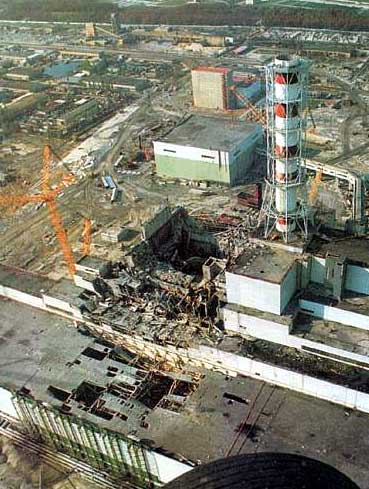
NOTE: The photo at the top of this post is a rare excellent shot of the destroyed reactor after the fire was put out - but before the Sarcophagus was constructed. I found it on the Chernobyl Tour site, where you can apparently book a tour of the area, including stops near the reactor and the neighboring ghost town of Pripyat. Tourists get special disposable clothing and respirators for the trip, and a complimentary computerized souvenir dosimeter reading (unfortunately, I'm not joking). Sorry, no photos allowed by Ukrainian law, which would explain the relative dearth of good images of the accident site available. However, some photos do appear on the Web, mostly from Ukrainian residents who visit the area and some from foreign press visits, which I'll be offering links to in the forthcoming special farkleberries feature on the Chernobyl accident anniversary. April 26th, 1986.

The photoessay site "Ghost Town", created by a young Ukrainian woman named Elena, has received over 2.5 million hits as of this writing; you'll find dozens of startling, one-of-a-kind images of the Chernobyl region accompanied by Elena's account of her visit. While access is strictly limited, Elena states that her father works for the government, and was able to arrange a permit for her motorcycle visit. Thank you, Walt, for this excellent link.

18 years is nothing in the life of a plutonium atom.

April 30, 2012

RadioActive! Casefiles: The Goiânia Accident (1987)

A little over one year after Chernobyl focused the world's attention on what was then the worst-ever civilian industrial nuclear disaster, the Brazilian city of Goiânia became the scene of another major radiological accident, resulting in several fatalities and widespread contamination. [A definitive 1988 report is available online at IAEA.org. See links and videos at the bottom of this post.]

On September 13, 1987, two men broke into the Instituto Goiano de Radioterapia (IGR), a partially demolished private cancer radiation therapy facility, and carted away a 300kg object in the belief they'd a found a valuable scrap metal item. Roberto dos Santos Alves and Wagner Mota Pereira took the object to Alves' home, about one-half kilometer north of the clinic, and began to dismantle it.

Over the next few days Alves and Pereira cut away at the metal exterior and managed to puncture the casing. Despite the fact both men started to become violently ill with vomiting and diarrhea, they continued their efforts, eventually cracking open the device - inside was a smaller metal canister with a movable "window." When the inner canister's window was pried open, it revealed a mysterious blue glow inside the inner shell. The men scraped away and extracted several small chunks of the glowing blue substance within with a screwdriver to keep as "souvenirs."

On September 18th, Alves sold the object to Devair Alves Ferreira, a nearby scrap dealer. Fascinated by the blue glow, Ferreira invited his family and friends over to see and touch the object. Ferreira's brother Ivo brought some of the powder from the canister home and spread it on his floor; innocently, his 6-year-old daughter Leide played with the powder, rubbed it on her skin, and even ingested a small quantity. Over the next several days, she and others who handled the glowing powder fell ill with vomiting, diarrhea, skin rashes, burns, and blisters.

Now fearing the object was "killing her family," the scrap dealer's wife Gabriela placed it in a plastic bag, boarded a bus, and brought it to the Vigilancia Sanitaria hospital on September 28. One of two doctors who met with Gabriela that day suspected the danger, and placed the bag on a chair in the outer hospital garden, as far away as possible from human contact.

The following morning, a visiting medical physicist with a borrowed radiation detector confirmed the doctor's fears - the hospital now was massively contaminated with radiation. The physicist, identified only as "W.P." in official reports, initially encountered a great deal of resistance alerting authorities to the severity of the emergency. By the end of the following day, W.P. convinced the Secretary for Health of Goias State and the Director of the Department of Nuclear Installations in CNEN to begin a massive search and cleanup operation in the area.

What Alves and Pereira unknowingly brought home from the abandoned clinic was a lead-shielded cancer therapy device containing a lethally radioactive cesium137 chloride (salt) core. All told, 130,000 people were tested for radiation at area hospitals, about 250 were found to be contaminated, and 20 required treatment for radiation sickness. Several houses within the neighborhood had to be demolished, and the rubble buried in a remote waste site. The cleanup effort also was hampered not only by the length of time that passed since the core was exposed and handled, but also by the fact the radioactive powder was water-soluble.

Four deaths are attributed to direct exposure to the cesium core: Leide and Gabriela Ferreira, and two of Devair Ferreira's scrapyard employees succumbed to radiation poisoning about a month after receiving radiation doses of 4.5 to 6.0 Gy (500 to 600 REM). Leide was buried in a lead coffin surrounded by concrete in a Goiânia cemetery, where crowds protested her burial, fearing their relatives' graves would be contaminated. Remarkably, Devair Ferreira survived his massive 7.0 Gy exposure.

The accident - rated 5 on the International Nuclear Event Scale [INES] - spread radioactive contamination throughout the Goiânia districts of Aeroporto, Central, and Ferroviários. To this date an estimated 7 of the device's nominal 50 TBq (terabecquerels) of radioactivity remain unaccounted for.

Image at top from the IAEA 1988 report on the Goiânia Accident. Lower image, by Alexander Sassaki/SIPA Press appears in "Radiation Accident Grips Goiania," by Leslie Roberts, Science, 1987 (see link below). *Featuring very effective use of Kraftwerk's "Radioactivity" as the backing track when one of the scrapyard employees discovers the cesium's blue glow in a dark storeroom, recalling the famous story of when the Curies found their radium-purifying lab apparatus aglow at night

January 21, 2007

California Truck Crash Load Contained 4g Plutonium

If you think all the hazardous radioactive material being transported across the country is safeguarded - or at least properly packaged and prepared for shipment on public thorofares - think again. The circumstances of last Tuesday's truck crash near the Mojave National Preserve are truly frightening if they're any indication of how carelessly lethal materials like plutonium might be traveling, perhaps in a vehicle rolling alongside you. From the San Bernadino Sun:
Baking soda, bunk beds, fire extinguishers - and a drum with plutonium-238. The truck that crashed Tuesday near Needles [CA] with a load of radioactive waste was a plain old commercial truck carrying plain old products.

When emergency workers checked the truck's manifest they were surprised that radioactive material was being shipped with ordinary goods. "This, in and of itself, is very alarming," said San Bernardino County Fire Marshal Peter Brierty, who also directs his agency's hazardous materials unit. Government and industry officials say shipping radioactive materials by commercial carriers is a perfectly safe, perfectly routine practice. The containers, the routes and the shipping companies are all heavily regulated, and there has never been an accident that resulted in a release of radiation, they said.

The radiation emitted by the truck's amount of plutonium-238 is trillions of times more than is allowed in drinking water, Brierty said. The four grams of plutonium involved in the crash would be roughly the volume of a pencil eraser. But that amount kicks out more than 60 curies, a measure of radioactivity.
In contrast, the drinking water standard is 15 picocuries per liter, or 15 trillionths of one curie.
...
The truck, pulling two trailers, crashed into a guardrail on eastbound Interstate 40, rupturing the tractor's fuel tank and causing the rear trailer to overturn and split open. The driver was unhurt. Part of the freeway was shut down for 18 hours. The heavily shielded, 500-pound, 55-gallon drum with the plutonium was in the front of the damaged trailer, California Highway Patrol Officer Michael Callahan said. The entire cargo had to be unloaded to get at the drum.

The drum was undamaged, and there was no leakage of radiation. [But,] "What the hell is that doing in that truck?" said Robert Halstead, an expert in the transportation of nuclear waste. [read full article]

March 17, 2006

Dounreay Fuel Pellets a Health Risk on Scots Beaches?

According to the Scottish Environment Protection Agency (SEPA), nuclear fuel particles found on beaches near the defunct [Caithness] Dounreay nuclear facility in Scotland only "pose low-level risk to human health." However, the agency conceded that some pieces of higher-activity fuel rods are still washing up on public beaches. From the Edie News Center:
Fragments of nuclear fuel, which continue to turn up on beaches near the former experimental reactor, prompted SEPA to commission an enquiry into their effects on human health in 1998.

Particles found at the site so far are "relatively low in activity." Visible skin burns could only occur if a person encountered a particle of higher activity, according to the Health Protection Agency (HPA), which carried out the research. It estimated the chances of that happening at one in 80 million.

But the report also warned of particles with a higher radioactivity being brought onto the beach from the seabed. Such particles have not been detected since monitoring began in 1999, however, the researchers said.

The HPA looked more closely at vulnerable groups, such as people walking dogs or digging for bait on the affected beaches, and the time they spent there. It considered the possibility of people accidentally swallowing or inhaling the particles, or sand from the beach being used for children's sandpits.
More: Risk of Dounreay particles 'low' [March 14th, 2006 on BBC web]
"Dounreay nuclear debris could kill," [BBC, 1999]
"Decommissioning Caithness Dounreay" [Power-Technology.com]
"The threats at Dounreay," [N-Base]

(Image CC from Wikimedia Commons)

February 22, 2006

UK Hospital Waste Truck Leaks Radiation

This week, a private nuclear materials handling firm in the United Kingdom apparently neglected to install a protective "plug" on a cask of radioactive hospital waste being transported by truck across Northern England, causing the cask to emit high levels of radiation during transit. "By pure chance," the radiation beam pointed downwards, away from other vehicles, and no injuries were reported. From the Telegraph UK:
A highly radioactive beam was emitted from a protective flask as it was driven 130 miles, for three hours, across northern England on a lorry, a court heard yesterday....The flask belonging to AEA Technology was being used to transport a piece of decommissioned cancer treatment equipment from Cookridge Hospital, Leeds, to the Sellafield complex, Cumbria on March 11, 2002.

A judge was told how the container was "found to be emitting a narrow beam of radiation, of a very high dose rate, vertically down from that package base". [read full article]
The radiation dose rates reportedly "were in the order of 100 to 1,000 times above what would normally be considered a very high dose rate and measurement was beyond the capabilities of normal hand-held monitoring equipment." The company responsible for handling the cask's transport, AEA Technology, "a privatised arm of the UK Atomic Energy Authority," has allegedly admitted to a series of recent safety breaches. The company was due to be fined in a court proceeding in connection with an earlier safety violations, but the court has delayed setting the final judgment in light of this new incident.

More details at The Australian and BBC News Online.

August 18, 2004

Engineer Witnessed Chernobyl From Within - And Lives To Tell

From New Scientist: "Alexander Yuvchenko was on duty at Chernobyl's reactor number 4 the night it exploded on 26 April 1986. He is one of the few working there that night to have survived. He suffered serious burns and went through many operations to save his life, and he is still ill from the radiation. He recently broke his silence for a documentary to be shown on the Discovery Channel. Here he speaks to Michael Bond about what happened that night:"
To get a clearer idea of what had happened we walked outside. What we saw was terrifying. Everything that could be destroyed had been. The entire water coolant system was gone. The right-hand side of the reactor hall had been completely destroyed, and on the left the pipes were just hanging. That was when I realised that Khodemchuk was definitely dead. The place where I was told he'd been standing was in ruins. The huge turbines were still standing, but everything around them was rubble. He must have been buried under that.

From where I stood I could see a huge beam of projected light flooding up into infinity from the reactor. It was like a laser light, caused by the ionisation of the air. It was light-bluish, and it was very beautiful. I watched it for several seconds. If I'd stood there for just a few minutes I would probably have died on the spot because of gamma rays and neutrons and everything else that was spewing out. But Tregub yanked me around the corner to get me out the way. He was older and more experienced.
Zero Hour: Disaster at Chernobyl airs on the Discovery Channel UK.

July 14, 2004

Missing Yankee Nuclear Fuel Rods Found

From the Champlain Channel WPTZ-TV
Fuel Rods Found In Pool At Plant

POSTED: 8:21 pm EDT July 13, 2004
UPDATED: 9:24 am EDT July 14, 2004

VERNON, Vt. -- Two highly radioactive pieces of spent nuclear fuel reported missing three months ago appear to have been where they were supposed to be all along.

A spokesman for the federal Nuclear Regulatory Commission said Vermont Yankee has told the NRC it found the fuel rods in the spent fuel pool at the plant. Vermont Yankee officials said last week they had found records at a General Electric laboratory in California that appeared to provide a key clue as to the fuel pieces' whereabouts.

Workers found the spent rods inside a cylinder that was sent to Vermont Yankee by GE specifically to hold the fuel segments. Searchers found the canister at the bottom of the spent rod pool and opened it up, discovering the rods late Tuesday afternoon. Vermont Yankee said it has updated its records to make sure something like that doesn't happen again.

July 08, 2004

Yankee Nuclear Powers Up Once More...Er, Hold That Thought

BURLINGTON, Vt. -- There was another scare Thursday morning at Vermont Yankee. This, after the nuclear power plant had just resumed full power Wednesday night following a fire that forced a 19-day shutdown.

Officials said an excess of oil caused black smoke to blow out of a furnace inside a building on the grounds Thursday morning. An onsite fire brigade shut off the furnace switch a little after 4 a.m. A representative for the plant's parent company said there was no damage or injuries from the incident.
I don't know about you, but I'd feel a little leery of uprating an old plant with repeated "problems" like this...and they still haven't found the missing two pieces of fuel rod.

June 24, 2004

Chernobyl Explorer: Alexander Borovoi

Dr. Alexander Borovoi is one of the people interviewed (his segment starts at 32:40) in this astounding BBC documentary from 1991, "Inside Chernobyl's Sarcophagus." Borovoi and his colleagues Viktor Popov, Yuri Buzulukov, and other "Stalkers" speak with western journalists for the first time since the accident. The scientists and BBC crew enter the Reactor 4 building taking measurements and video footage of its wreckage, in extreme haste (due to the radiation levels) and incredibly dangerous conditions. Footage had to be shot by actual cameramen working quickly, as the searing radiation and rough ground caused robotic camera rigs to mire or fail within minutes. In one segment we see a clever improvisation: the team jerry-rigged a small videocamera onto a wire remote-controlled child's toy tank. The end of the documentary is an interview with Borovoi and Popov five years later, where we revisit their dire predictions, and the surviving members of the "bio-robot" team.


[UPDATE: Borovoi's 2008 presentation detailing the state of the Chernobyl corium, or "melt." (PowerPoint on SarNet.org] 64-year old Alexander Borovoi is a brave man, and a very lucky one; he is one of the "extreme explorers" who periodically examined the inside of the Chernobyl sarcophagus to spot developing problems. From US News and World Report:
The line between hero and victim was thin in the first frantic weeks after the accident. Firemen fought the flames but lacked instruments to tell them they faced lethal doses of radiation. Military helicopter pilots hovered in the radioactive smoke plume to smother the burning reactor with tons of sand and lead, but their bombing runs missed the mark.

Yet the catastrophe–and the chance for heroism–did not end when the fire burned out. In the months and years that followed, a band of scientists led by physicist Alexander Borovoi explored the reactor's corpse to make sure it could not reawaken. Working in a hot, dark labyrinth where lingering radiation could kill within minutes, they mapped and analyzed tons of reactor fuel remaining. It was heroism of a quieter and more effective order than had come before. "Borovoi knew what he was doing," says Harvard University nuclear physicist Richard Wilson, "and he had the imagination and common sense" to succeed.

To find the remnants, Borovoi and his men had to venture into the heart of the destroyed reactor. Robots were not up to the job; they got stuck in debris or ran amok, circuits scrambled by radiation. "We had only one kind of robots [that worked]," says Borovoi. "Biorobots–ourselves." They called themselves "stalkers." Coveralls, gloves, and a respirator were their protection–lead suits were too bulky for dashes through the reactor. A fall or wrong turn could be fatal.

Late in 1986, beyond a gantlet of highly radioactive rooms and narrow passages, the stalkers discovered a glassy, black formation resembling a giant elephant's foot. Getting a piece to analyze was not easy. It was so fiercely radioactive that the scientists could spend only seconds near it, and its surface shrugged off a drilling machine and an ax. Finally a marksman took aim with a Kalashnikov rifle. The shards gave the first clues to what had happened to the nuclear fuel and the chance of a future catastrophe.

[read full article]

Vermont Yankee Plant to Remain Offline Indefinitely

Following a recent transformer fire at the Vermont Yankee nuclear power plant, officials have decided to keep the facility offline for more thorough investigation.

From the Champlain Channel:
UPDATED: 10:40 am EDT June 24, 2004

BURLINGTON, Vt. -- Vermont Yankee remained off-line Thursday after two fires there on Friday, but Entergy now says the plant's safety system didn't respond the way it should have.

Vermont Yankee officials said the accident was far less serious than originally feared, but critics charge it's the pattern they're concerned about. It's just one safety lapse after the next, they said. "A fire at a nuclear plant is a big deal," one customer said. Five days after the fire there, critics call the accident more serious -- and more telling -- than first believed.

"Powerplants have what's called a bathtub curve," said longtime nuclear engineer Arnie Gundersen. "They fail a lot when they're new. They fail a lot when they're old. In between though, they don't fail a lot. I have been saying that they're on the upslope of the bathtub curve, and we should see more of these failures as the plant gets older." Gundersen cites three forced shutdowns in nine months due to broken valves and pumps.

Vermont Yankee turns 32 this year, but marks the year with a series of embarrassments: cracks in the steam dryer, a pair of missing fuel rods and, most recently, the transformer fire. Public service commissioner David O'Brien sent the state nuclear engineer to Vernon this week for a closer look. "We've got to find out what caused it," Public Service Commissioner David O'Brien said. "Was it a problem with the equipment? Was it a problem with maintenance? We've got to find that out first."

Officials hope to find out what caused the accident within a week. The plant will remain off-line indefinitely. The NRC, meanwhile, still plans to assess Vermont Yankee for its proposed uprate later this summer.

May 10, 2004

Nuclear TV: PBS' Look Back at TMI, NOVA's Back to Chernobyl

(UPDATE 6/14/12: While "Meltdown at Three Mile Island" and "Back to Chernobyl" are not to my knowledge available on PBS' website, or through services like Netflix (unlike many other titles in the excellent American Experience series), with a little searching you should have little trouble finding them on YouTube in most countries.)

While you won't find many nuclear-energy related videos at your local video store (documentaries, anyway) there are some noteworthy releases available at libraries and at retail - mostly from transcription dealers and "deep-catalog" mail order outlets like Amazon.com. Being fortunate enough to have access to resources like the University of Chicago and Harold Washington libraries, I tracked down some excellent programs I'd like to recommend: but I should mention that none of the titles here are available in DVD format at this point, only as VHS tapes.

PBS' The American Experience: Meltdown at Three Mile Island (60 min.) replays the events of America's worst nuclear accident in 1979. With vintage news footage and contemporary interviews with key response team players like former Pennsylvania governor Dick Thornburgh and Attorney Governor William Scranton, this documentary is an exceptional inside look back at those panicked days near Harrisburg. This was a personally fascinating retrospective for me; not only for the content, but because I was living in Central New Jersey - less than two hours away by car from Three Mile Island - at the time of the accident.

As you watch the events unfold, what comes to mind is how unnecessary much of the TMI media confusion was in retrospect, although it may have been unavoidable at the time. For hours on end, emergency responders and the PA governor's office were unable to reach the power plant's operators, because the ordinary landlines were jammed tight with reporters' calls from around the country. No "Red Phone" hot-line was active, no two-way radio, and of course, no cell phones: the stricken plant was essentially incommunicado during some of the most crucial hours.

NOVA: Back to Chernobyl (originally aired February 14th, 1989) is an out-of-print title, but well worth tracking down, and you may likely find a copy at a library near you. Correspondent Bill Kurtis travels to the Soviet Union for a visit to the reactor site three years after the incident, and speaks with a number of survivors and eyewitnesses. Darkly humorous are the scenes with Kurtis' chatty ushanka-capped [уша́нка], Geiger counter-toting liason, Dr. Richard Wilson, who tries to reassure the journalist that the rather alarming radiation readings are nothing to worry about:
Kurtis: "Professor, how far do you think we are now from the reactor?"
Wilson: "Oh, about 30 miles."
Kurtis: "Should we check the readings?"
Wilson: "You’ll hear a high-pitched whistle as it checks the battery first. You’ll begin to hear some clicking as the readings start coming in. That’s a pretty good background, about the same as it was in Kiev. Let me just check the instrument. I’ll pull a source out of my case here."
Kurtis: "That level would seem to be the natural background."
Wilson: "That’s the natural background, but now you can test the beta ray [remember these are really particles] source, and you can hear it clicking furiously."
Kurtis: "What will the level be around the reactor itself?"
Wilson: "On this scale, around the reactor itself, we’ll find the reading to be off-scale, and we’ll have to change to the next scale. It’s about 30 times the background level around the reactor itself."
Kurtis: "Will that be any danger to us?"
Wilson: "No, you can be there for a year and get the amount of radiation that a worker is allowed to have in a year."
If you can't locate a copy of the tape, try this 2001 online document by Steve Cooperman containing a partial transcript with detailed notes on the program available from UCLA [http://coke.physics.ucla.edu/laptag/mchs/Nova-Chernobyl-video-notes.doc (Caveat: Microsoft Word™ .doc]

May 04, 2004

18th Anniversary of the Chernobyl Disaster

view of the near-vertical reactor head of the Chernobyl 4 RBMK-1000, courtesy INSP.comThey say there are no coincidences in life.

Today - on the precise anniversary of the Chernobyl disaster - I received my first completely trashed Amazon.com shipment (which I returned tout suite). I ordered VHS tapes of two ABC Nightline special reports on the incident: Chernobyl Nuclear Disaster (aired April 28th, 1986, when the West first heard of the reactor accident) and Chernobyl Plant - The Aftermath (aired April 22, 1987). Since I didn't pay Chernobyl much mind in 1986, I thought the archival program footage would be fascinating (seeing a young Ted Koppel is always good for a chuckle).

I'm sure it will be when the replacements arrive. The shipment I received today appeared to have been either run over by a car or stepped on by Ruben Studdard: the box was accordioned into a hourglass shape, and I knew it was bad news when I shook it like a Christmas present. Rattle, rattle, ching. The tapes inside were literally smashed into black plastic shards. Sigh. Neeeeext! We'll see if Amazon holds to their reportedly strong returns policy.

And, the news breaks that the Vermont Yankee nuclear power station in my old neck of the woods "lost" two pieces of highly radioactive spent-fuel rod:
From USA Today:
The operators of the Vermont Yankee nuclear power plant reported the missing pieces Wednesday, saying they were not where they were supposed to be in the large pool used to store fuel rods. One of the missing pieces is about the size of a pencil. The other is about as thick but is 17 inches long.

The spent fuel rods are highly radioactive and would be fatal to anyone who came in contact with them without being properly shielded, Nuclear Regulatory Commission spokesman Neil Sheehan said. Spent nuclear fuel could be used by terrorists to construct so-called dirty bombs that would spread deadly radiation with conventional explosives.

"We do not think there is a threat to the public at this point. The great probability is this material is still somewhere in the pool," Sheehan said. The pieces could also have been sent years ago to a testing laboratory or a low-level nuclear waste disposal facility. The pieces were part of a fuel rod that was removed in 1979 from the Vermont Yankee reactor, which is currently shut down for refueling and maintenance.
Burlington, VT's WPTZ-TV today reports that the missing pieces are, well, still missing. I don't live near Burlington these days, but that doesn't make me feel much better. It's like hearing that your downstairs neighbor's pet Black Mamba turned up missing.

So, my research into Chernobyl (which includes scouring the Web and government sites, and the University of Chicago and Harold Washington Libraries) has been slightly delayed. However, for the curious, I have a selection of choice hand-picked links that will provide multi-national insights into the incident, and its continuing aftermath.
The German nuclear-safety agency GRS [Gesellschaft für Anlagen und Reaktorsicherheit, mbH] has a well-illustrated, informative 179-page free online technical report called "The Accident and the Safety of RBMK Reactors" [large PDF file, 5Mb].

If you enjoy government reports and "blue books," visit the World Nuclear Association's Chernobyl page, which includes links to UNSCEAR [United Nations Scientific Committee on the Effects of Atomic Radiation, which published several comprehensive reports on the Chernobyl disaster - many which are available here as free PDF downloads.

Watch This: Chernobyl.co.uk, a UK site which features a link to the BBC's recent 30-minute program [streaming RealPlayer video] on Chernobyl, featuring a look at the history of nuclear power in the former Soviet Union as well as a look inside Ukraine's Exclusion Zone towns. Highly recommended: this program illustrates that the deteriorating reactor site is still an issue of pressing concern through Europe, while it has been all but overshadowed here in the U.S.

Watch This: though the bulk of Chernobyl news coverage occurred before the age of streaming video, the post-date digitized BBC retrospective of the Chernobyl disaster [RealPlayer required] is a wistfully immediate - if lo-res - look back at those fateful days in April 1986.

Ukrainian biker gal (and young scientist) Elena is the Kidd [sic] of Speed: her wildly popular site, Ghost Town, features dozens of startling photos and rueful, blustering commentary from her motorcycle tour through the post-apocalyptic Exclusion Zone in Pripyat': part National Geographic expedition, part Jackass-meets-Evel Knievel. Strange thing is, I'd probably do it too, given the opportunity and a lead X-ray apron - but I'd prefer an enclosed vehicle, like a Bradley.

Got Euskadi? The Basque Website of Pripyat.

Have Paris, Rome, and the Caribbean lost their appeal? Been there, done that? How about a guided group tour through Chernobyl? I don't know if it's a legitimate enterprise, but you can apparently book a tour through the Exclusion Zone via Ukrainian Web Chyornobyl' Tour. You get complimentary disposable outerwear and shoes, and a souvenir computerized dosimeter printout that certifies how much radiation you absorbed during your visit.

The Jet Propulsion Laboratory's Pioneer Robot pages, with photos and diagrams of the Red Zone Robotics radiation-hardened explorer robot that will be used to excavate and explore the hot ruin inside the Sarcophagus.

A recent Kazakhstan Kazinform press release from March, 2004, warning that trouble at the Chernobyl Sarcophagus could be imminent.

From a nation that is also highly dependent on nuclear energy, but has thankfully suffered neither a Chernobyl nor a Three Mile Island type incident - the Canadian Nuclear Association's report on Chernobyl.

USGS satellite photos showing changes in the Chernobyl region from 1986 to 1992.

An August, 1986 EPA Bulletin on short-term American response to the Chernobyl disaster.

Gla55pak.com has compiled some unusual Chernobyl images here, and proclaims "I have a sick curiosity - more of an impulse - to be there that night and watch the thing light up. I would gladly take a good dose just to have seen it. It is, after all, like an immense train wreck that I just can't help but see." Also: link to Disenchanted.com's take on the Chernobyl and TMI incidents, called "Fear's just bad for business".

A high-resolution satellite image of the Chernobyl region from the Jet Propulsion Laboratory, suitable for desktop backgrounds.

Some of the best photos of the site I have seen are on the INSP's [International Nuclear Safety Program] Digital Library Website, where you can view over 800 color and black-and-white images, including the one at the top of this post.