Most of us recognize Listeria as one of the bacteria found in soil, raw and undercooked foods, and unpasteurized dairy products, which can cause serious illness including a high risk of miscarriage in pregnancy. However, researchers at Yeshiva University's Albert Einstein College of Medicine have discovered this pathogen can be tagged with a radioisotope and drafted to fight a dreaded disease: metastatic cancer of the pancreas.
"We're encouraged that we've been able to achieve a 90 percent reduction in metastases in our first round of experiments...[w]ith further improvements, our approach has the potential to start a new era in the treatment of metastatic pancreatic cancer."
As Dr. Dadachova also explains in the Albert Einstein College of Medicine press release,
"We chose rhenium because it emits beta particles, which are very effective in treating cancer...also, rhenium has a half-life of 17 hours, so it is cleared from the body relatively quickly, minimizing damage to healthy tissue."
[27 A]nalyzed samples of [the] tongue and diaphragm of animals slaughtered during the hunting season 2012/2013 [showed] level[s] of Cesium-137 higher than the threshold specified by Regulation 733 of 2008 as the tolerable limit in the event of a nuclear accident. According to the deputy of the Piedmont Region, Roberto Ravello, alarmism should be avoided because the health risks would be "contained and controlled."
According to Elena Fantuzzi, head of the Institute of Radiation Protection ENEA, the most immediate explanation is that the contamination originated from the 1986 Chernobyl accident. However, she cautions, (translation via GoogleTranslate) "[W]e must also consider the nuclear sites in the area, including the central Trino Vercellese ["Enrico Fermi" nuclear plant] dismantled in 1987 and the experimental site Enea, in Saluggia...[We can not exclude] the trail of toxic waste." Gian Piero Godio, a nuclear expert in the Legambiente Piemonte and Val d'Aosta region adds, "[There may be o]ther explanations....the district of Valsesia has no radioactive source[s]." More: Video news story (in Italian)
While having much of the Internet at one's disposal through search engines is a wonderful thing - especially when you know what you're looking for - specialized blogs like the new Chernobyl Database (launched February 2013) also serve a vital purpose: they can help point you in the direction of new research studies and findings you may have been unaware of.
Chernobyl Database, which I believe is based in Japan, focuses fairly narrowly on posting papers studying the effects of radiation and radioactive contamination on the environment and health, but it also ventures deeply by including links to research going back several decades. Entries are primarily in English, with separate categories for articles published in Japanese and Russian. I think you'll find it a valuable resource.
Mitubishi Heavy Industries, Ltd. of Japan announced it will begin marketing early next year the Astrocam 7000 HS, a new type of video camera that can show a superimposed display of radioactivity on its wide-angle 180-degree image, allowing cleanup crews and emergency responders to see "hot spots" in real time. The Asahi Shimbun reports,
"The portable camera, which will apply technology jointly developed with the Japan Aerospace Exploration Agency (JAXA), is designed to allow for more efficient clean-up of radioactive contamination, an issue of great concern in Japan because of the nuclear disaster last year. The camera will use technology now in place on observation equipment aboard the ASTRO-H X-ray astronomy satellite operated by JAXA.
Tadayuki Takahashi, a professor of space physics at JAXA and project manager of the ASTRO-X, said, "The camera can measure radiation in high places, such as on roofs, and will lead to more efficient decontamination of radiation." Using two types of semiconductor sensors, the direction and strength of gamma rays emitted by radioactive materials such as cesium are measured and brought to light as a superimposed image on the visible landscape."
The seat material, including body armor parts (shoulders, arms, chest/abdominal area, thighs, neck), consists mainly of tungsten sheet, which offers excellent radiation shielding capability. Although the seat weighs a considerable 130 kilograms (kg), individual parts weigh less than 20kg and most of their weight is integrally supported by the seat, so the burden on the operator is minimal.
In addition, the operator can put on and remove the armor-like parts easily by opening/closing the front like a vest...these features provide a high rate of radiation shielding while simultaneously minimizing fatigue during continuous work and inconvenience to machine operation from wearing such shielding.
Here, Mitsubishi Heavy Industries demonstrates the Astrocam and explains its technology in this one-hour press conference video (in Japanese, no subtitles).
[Image of demonstration camera view courtesy of Asahi Shimbun Online] More on the Mitsubishi Astrocam 7000HS camera:
The Pentagon has released data showing radiation dosage estimates for the thousands of American nationals and military personnel in Japan at the time of the 2011 earthquake and tsunami and subsequent nuclear crisis at Fukushima. Named Operation Tomodachi, the registry seeks to "[provide] interested individuals with location-based radiation dose estimates for adults and children for the period of greatest potential exposure, from March 12, 2011 through May 11, 2011." According to the September 5th news report in Reuters,
"[T]he highest rate of adult exposure [was] at Camp Sendai, just north of Fukushima, where the estimated adult dose of whole body radiation was 0.12 rem and 1.20 for the thyroid - the organ most affected by radiation. By comparison, a full-body CAT scan yields a whole body exposure of 5.0 rem. Those American personnel who were stationed at Camp Sendai who check the website will see a message saying: 'Your whole-body and thyroid radiation dose estimates are well below levels associated with adverse medical conditions.'"
The Google API-based map [accessible here], which shows selected measurement areas with links to dosage estimate reports, is expected to be completed by the end of 2012, and will also incorporate dosage estimates and data for about 8,000 individuals who had direct radiation measurements taken.
For more background information on the Goiânia accident that claimed the lives of at least 4 people, sickened dozens with radiation illness, and caused widespread contamination (INES 5) throughout several districts surrounding the accident epicenter, see our April 30, 2012 post: http://corium.blogspot.com/2012/04/radioactive-casefiles-goiania-accident.html
This story from Japan illustrates how radioactive contamination can be dispersed by animal vectors, as well as weather, water, and human intervention: NHK News reports cesium has been found in the brains of wild rats in the forested area about 30km from the beleaguered Fukushima Daiichi nuclear plant.
Apodemus speciosus is actually a species called the Large Japanese Field Mouse, so I'm uncertain if the article is referring to both rats and mice, or just the Large Japanese Field Mice. The linked NHK News article contains a 1:37 video (in Japanese) which may provide a more detailed explanation. Judging from size alone, the rodents shown captured in the video look to be A. speciosus, not the typical species of domestic rat common in Japan.
[English text via Google Translate]
Highly Radioactive Cesium from Rat Cortex
Radioactive cesium in the 3100 Becquerels [range] was detected in rats in the wild, captured in the forest approximately 30 km from [the] nuclear power plants. An expert at Fukushima Daiichi Tokyo Electric Power Company [said] there is a need to examine continuously the impact on wildlife.
...Apodemus speciosus was captured wild in October and December last year in the forest. As a result of examining the concentration of radioactive cesium accumulated in the body of 12 mice...on average, per kilogram, from rats captured in the village of Kawauchi [measured at] 3,100 becquerels, in Kitaibaraki 790 becquerels has been detected.
Radiation dose in the air of the capture location, Kawauchi village, is in the [range of] 0.2 μSv - 3.11 μSv per hour, and [in] Kitaibaraki, where radiation dose is high, [there was a tendency to find] higher concentrations of radioactive materials in the rat[s]. The results of the survey, Yoshihisa Kubota, Sub-Leader of the National Institute of Radiological Sciences, [indicate] "There is a need to examine ... rats to study the effects of radiation to the same extent as human animals, continue to impact on wildlife of radioactive material."
Linked below are a few studies that may give an idea of how radiation spread by animal vectors like rats contributes to environmental contamination: when contaminated vectors are consumed by predators, if vector and subsequent predator wastes contain appreciable radioactive contamination, and also, if vectors die naturally, how much contamination is left in the soil, landfills, etc. According to one of the articles linked below, larger wildlife like deer pose a greater risk due to their larger body size, wider habitat range, and longer lifespan. Rats in particular would be a particularly important vector to study, given their affinity for human dwellings and garbage dumps. Please note that academic or library access may be needed to access the linked journal papers.
"You'd better find another job," said Mae Keane's boss at the Waterbury Clock Company of Vermont, when her luminous dial-painting productivity flagged. Mae thought the radium paint was too bitter-tasting, so she refused to use her colleagues' "lip-pointing" technique to create a sharp tip on her paintbrush by placing it in her mouth.
This bit of insubordination may have cost her a well-paid (a reported 8 cents per dial; about $1.00 today) summer factory job in 1926, but it probably saved her life. Back then, Mae's workplace friend Elsie gave her some frightening advice: never have a tooth pulled, because the wound would never heal.
For years, Middlebury, Vermont high school freshman Tim Cohn had been interested in his aunt Mae's accounts of working at the Waterbury Clock Company. Now Cohn's research on his aunt, her experiences, and the attempt to cover up what happened to the Radium Girls have made him a finalist in the National History Day contest, to be held at the University of Maryland in College Park, Md. this June 10-14. Congratulations, Tim - and best wishes to your aunt Mae!
UPDATE: Tim Cohn was awarded the bronze medal in the Senior Individual Exhibit category at National History Day. Our sincere congratulations!
Here is a small sampling of links dedicated to the remarkable Radium Girls story; not just those who worked at the Waterbury plant, but those at locations around the nation in the 1920's and 30's.
On May 25th, Warner Brothers will release a science fiction/supernatural horror film set in Pripyat, the abandoned "ghost town" adjacent to the ruins of Chernobyl's reactor complex. The crumbling town, seen for years on sites like "Kidd of Speed," seems a perfect backdrop for fright flicks. Let me say at the outset that I'm a huge movie fan: cheesy, gory horror flicks are some of my favorites. That said, as someone who was profoundly affected as a college freshman by live unfolding news accounts of Chernobyl (in fact, those memories are one of the main reasons I started this blog back in 2004) I have to admit I find the film's concept a bit troubling and distasteful.
I suspect the primary target audience, if not the filmmakers themselves, probably view the Chernobyl tragedy as just another creepy historical footnote, something awful that happened a long time ago in a country far away. With popular video games like "Stalker: Shadow of Chernobyl," and the film's central premise of "extreme tourism" into the Exclusion Zone, Chernobyl's legacy has mushroomed (if you'll forgive the expression) into a booming cottage industry of curiosities for the "zombie apocalypse" crowd.
Since the nuclear strikes on Japan in World War II, popular culture from 50's Pulp and Godzilla to the Hulk and Spiderman have conflated nuclear mishaps with Bug Eyed Monsters. But I wonder: would movie executives and audiences respond favorably to a zombie apocalypse tale set in a different contemporary locale - say, the Japanese Tsunami of 2011 and the Fukushima Disaster? The Union Carbide Disaster in Bhopal, India? Hurricane Katrina? The terrorist attacks of 9/11?
The passage of time always seems to be an insulator against troubling memories; the human race couldn't survive otherwise. What's sad is that if nothing else, "Chernobyl Diaries" highlights how a mere two-and-a-half decades can generate cultural amnesia of the immense sacrifice and suffering that occurred in Europe and that continues to this day. Thinking charitably, maybe any kind of attention to the Chernobyl tragedy could generate a resurgence of interest in the continuing human need there; after all, they say there's no such thing as bad publicity.
Perhaps the least the makers of "Chernobyl Diaries" could do is donate a portion of their profits to one of the many charitable organizations that provide ongoing support to Chernobyl's victims, many born decades later. Those who were there and survived live with scarred minds, hearts, and/or bodies: every living being born in the afflicted region since April 26, 1986 will carry Chernobyl's memory into the far distant future.
A little over one year after Chernobyl focused the world's attention on what was then the worst-ever civilian industrial nuclear disaster, the Brazilian city of Goiânia became the scene of another major radiological accident, resulting in several fatalities and widespread contamination. [A definitive 1988 report is available online at IAEA.org. See links and videos at the bottom of this post.]
On September 13, 1987, two men broke into the Instituto Goiano de Radioterapia (IGR), a partially demolished private cancer radiation therapy facility, and carted away a 300kg object in the belief they'd a found a valuable scrap metal item. Roberto dos Santos Alves and Wagner Mota Pereira took the object to Alves' home, about one-half kilometer north of the clinic, and began to dismantle it.
Over the next few days Alves and Pereira cut away at the metal exterior and managed to puncture the casing. Despite the fact both men started to become violently ill with vomiting and diarrhea, they continued their efforts, eventually cracking open the device - inside was a smaller metal canister with a movable "window." When the inner canister's window was pried open, it revealed a mysterious blue glow inside the inner shell. The men scraped away and extracted several small chunks of the glowing blue substance within with a screwdriver to keep as "souvenirs."
On September 18th, Alves sold the object to Devair Alves Ferreira, a nearby scrap dealer. Fascinated by the blue glow, Ferreira invited his family and friends over to see and touch the object. Ferreira's brother Ivo brought some of the powder from the canister home and spread it on his floor; innocently, his 6-year-old daughter Leide played with the powder, rubbed it on her skin, and even ingested a small quantity. Over the next several days, she and others who handled the glowing powder fell ill with vomiting, diarrhea, skin rashes, burns, and blisters.
Now fearing the object was "killing her family," the scrap dealer's wife Gabriela placed it in a plastic bag, boarded a bus, and brought it to the Vigilancia Sanitaria hospital on September 28. One of two doctors who met with Gabriela that day suspected the danger, and placed the bag on a chair in the outer hospital garden, as far away as possible from human contact.
The following morning, a visiting medical physicist with a borrowed radiation detector confirmed the doctor's fears - the hospital now was massively contaminated with radiation. The physicist, identified only as "W.P." in official reports, initially encountered a great deal of resistance alerting authorities to the severity of the emergency. By the end of the following day, W.P. convinced the Secretary for Health of Goias State and the Director of the Department of Nuclear Installations in CNEN to begin a massive search and cleanup operation in the area.
What Alves and Pereira unknowingly brought home from the abandoned clinic was a lead-shielded cancer therapy device containing a lethally radioactive cesium137 chloride (salt) core. All told, 130,000 people were tested for radiation at area hospitals, about 250 were found to be contaminated, and 20 required treatment for radiation sickness. Several houses within the neighborhood had to be demolished, and the rubble buried in a remote waste site. The cleanup effort also was hampered not only by the length of time that passed since the core was exposed and handled, but also by the fact the radioactive powder was water-soluble.
Four deaths are attributed to direct exposure to the cesium core: Leide and Gabriela Ferreira, and two of Devair Ferreira's scrapyard employees succumbed to radiation poisoning about a month after receiving radiation doses of 4.5 to 6.0 Gy (500 to 600 REM). Leide was buried in a lead coffin surrounded by concrete in a Goiânia cemetery, where crowds protested her burial, fearing their relatives' graves would be contaminated. Remarkably, Devair Ferreira survived his massive 7.0 Gy exposure.
The accident - rated 5 on the International Nuclear Event Scale [INES] - spread radioactive contamination throughout the Goiânia districts of Aeroporto, Central, and Ferroviários. To this date an estimated 7 of the device's nominal 50 TBq (terabecquerels) of radioactivity remain unaccounted for.
Image at top from the IAEA 1988 report on the Goiânia Accident. Lower image, by Alexander Sassaki/SIPA Press appears in "Radiation Accident Grips Goiania," by Leslie Roberts, Science, 1987 (see link below).
Pra não dizer...que não falei do Césio-137: from Brazil, focusing on the radiological incident. Very interesting and informative blog, well worth visiting, even if (like me) you need to use Web translation tools for the original Portuguese.
"Radiation Accident Grips Goiania," by Leslie Roberts, Science (New Series), Vol. 238, No. 4830 (Nov. 20, 1987), pp. 1028-1031. Published by: American Association for the Advancement of Science [JSTOR subscription required]
[Note: the URL for this video has been changed] On YouTube, you can view an informative 37-minute TV documentary on the Goiânia accident (in Portuguese) as part of the Linha Direta investigative series, hosted by Domingos Mireilles, containing a detailed re-enactment*: Odesson Alves Ferreira, president of Associação da Vítimas do Césio 137, is interviewed beginning at timestamp 4:18.
IAEA Video: The Legacy of the Goiânia Radioactive Source Accident:
YouTube video: "Enterro de Leide das Neves Ferreira - Apedrejamento e Vandalismo no Cemitério Parque" ("Burial of Leide das Neves Ferreira - Stoning and Vandalism in Cemetery Park")
Recently, we took a field trip [with a SPER Scientific portable radiation monitor in tow] to Red Gate Woods near Willow Springs, IL, home of the Plot M nuclear disposal site. The area is open to the public but a bit hard to find, located off a small side trail in the forest preserve. While radiation readings at the Plot M stone monument were essentially background-level, one of the numerous test well caps (kept padlocked) did appear to have higher than normal radiation counts, averaging about 0.1-0.3 mR/hr as seen from this short video clip.
Were there any other kind? This striking film footage (taken by the late Vladimir Shevchenko, who died of radiation exposure soon after this film was made) was posted to YouTube several years ago, but as we approach the anniversary of the Chernobyl accident, these images show the stunning disregard for radiation protection given to the first responders and "liquidators." They dig, film, and cart away searingly radioactive debris using only conventional work gloves, cloth facemasks, and construction respirators, seemingly unaware or dismissive of the immediate danger they face. Some later web versions of Shevchenko's film have background music added, but I think this silent version with supertitles conveys its potent message best.
So, my research into Chernobyl (which includes scouring the Web and government sites, and the University of Chicago and Harold Washington Libraries) has been slightly delayed. However, for the curious, I have a selection of choice hand-picked links that will provide multi-national insights into the incident, and its continuing aftermath.
If you enjoy government reports and "blue books," visit the World Nuclear Association's Chernobyl page, which includes links to UNSCEAR [United Nations Scientific Committee on the Effects of Atomic Radiation, which published several comprehensive reports on the Chernobyl disaster - many which are available here as free PDF downloads.
Watch This: Chernobyl.co.uk, a UK site which features a link to the BBC's recent 30-minute program[streaming RealPlayer video] on Chernobyl, featuring a look at the history of nuclear power in the former Soviet Union as well as a look inside Ukraine's Exclusion Zone towns. Highly recommended: this program illustrates that the deteriorating reactor site is still an issue of pressing concern through Europe, while it has been all but overshadowed here in the U.S.
Watch This: though the bulk of Chernobyl news coverage occurred before the age of streaming video, the post-date digitized BBC retrospective of the Chernobyl disaster [RealPlayer required] is a wistfully immediate - if lo-res - look back at those fateful days in April 1986.
Ukrainian biker gal (and young scientist) Elena is the Kidd [sic] of Speed: her wildly popular site, Ghost Town, features dozens of startling photos and rueful, blustering commentary from her motorcycle tour through the post-apocalyptic Exclusion Zone in Pripyat': part National Geographic expedition, part Jackass-meets-Evel Knievel. Strange thing is, I'd probably do it too, given the opportunity and a lead X-ray apron - but I'd prefer an enclosed vehicle, like a Bradley.
Have Paris, Rome, and the Caribbean lost their appeal? Been there, done that? How about a guided group tour through Chernobyl? I don't know if it's a legitimate enterprise, but you can apparently book a tour through the Exclusion Zone via Ukrainian Web Chyornobyl' Tour. You get complimentary disposable outerwear and shoes, and a souvenir computerized dosimeter printout that certifies how much radiation you absorbed during your visit.
The Jet Propulsion Laboratory's Pioneer Robot pages, with photos and diagrams of the Red Zone Robotics radiation-hardened explorer robot that will be used to excavate and explore the hot ruin inside the Sarcophagus.
From a nation that is also highly dependent on nuclear energy, but has thankfully suffered neither a Chernobyl nor a Three Mile Island type incident - the Canadian Nuclear Association's report on Chernobyl.
Gla55pak.com has compiled some unusual Chernobyl images here, and proclaims "I have a sick curiosity - more of an impulse - to be there that night and watch the thing light up. I would gladly take a good dose just to have seen it. It is, after all, like an immense train wreck that I just can't help but see." Also: link to Disenchanted.com's take on the Chernobyl and TMI incidents, called "Fear's just bad for business".
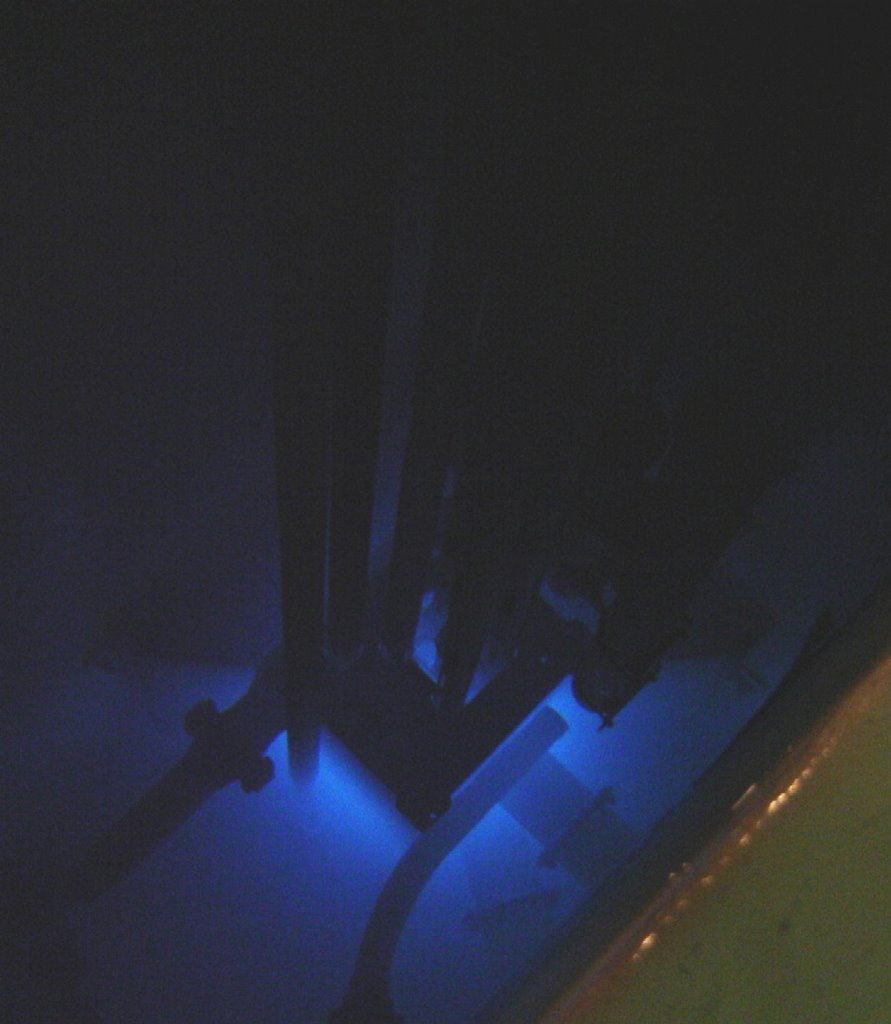
A RadioActive! reader sent us this fascinating image of blue Cerenkov radiation from Ohio State University's research reactor:
"...attached is a photo...of our research reactor at OSU, which I took from the pool-top during operation at about 50 kW (thermal). The blue Cerenkov glow caused by photoelectrons, Compton electrons, and beta particles is evident here, but [in my opinion] is much prettier at our licensed power of 500 kW! Regards, Carl Willis"
Click on the image at left to expand to a full-size [890 x 1024] detailed image.
According to the Scottish Environment Protection Agency (SEPA), nuclear fuel particles found on beaches near the defunct [Caithness] Dounreay nuclear facility in Scotland only "pose low-level risk to human health." However, the agency conceded that some pieces of higher-activity fuel rods are still washing up on public beaches. From the Edie News Center:
Fragments of nuclear fuel, which continue to turn up on beaches near the former experimental reactor, prompted SEPA to commission an enquiry into their effects on human health in 1998.
Particles found at the site so far are "relatively low in activity." Visible skin burns could only occur if a person encountered a particle of higher activity, according to the Health Protection Agency (HPA), which carried out the research. It estimated the chances of that happening at one in 80 million.
But the report also warned of particles with a higher radioactivity being brought onto the beach from the seabed. Such particles have not been detected since monitoring began in 1999, however, the researchers said.
The HPA looked more closely at vulnerable groups, such as people walking dogs or digging for bait on the affected beaches, and the time they spent there. It considered the possibility of people accidentally swallowing or inhaling the particles, or sand from the beach being used for children's sandpits.
 Most of us recognize Listeria as one of the bacteria found in soil, raw and undercooked foods, and unpasteurized dairy products, which can cause serious illness including a high risk of miscarriage in pregnancy. However, researchers at Yeshiva University's Albert Einstein College of Medicine have discovered this pathogen can be tagged with a radioisotope and drafted to fight a dreaded disease: metastatic cancer of the pancreas.