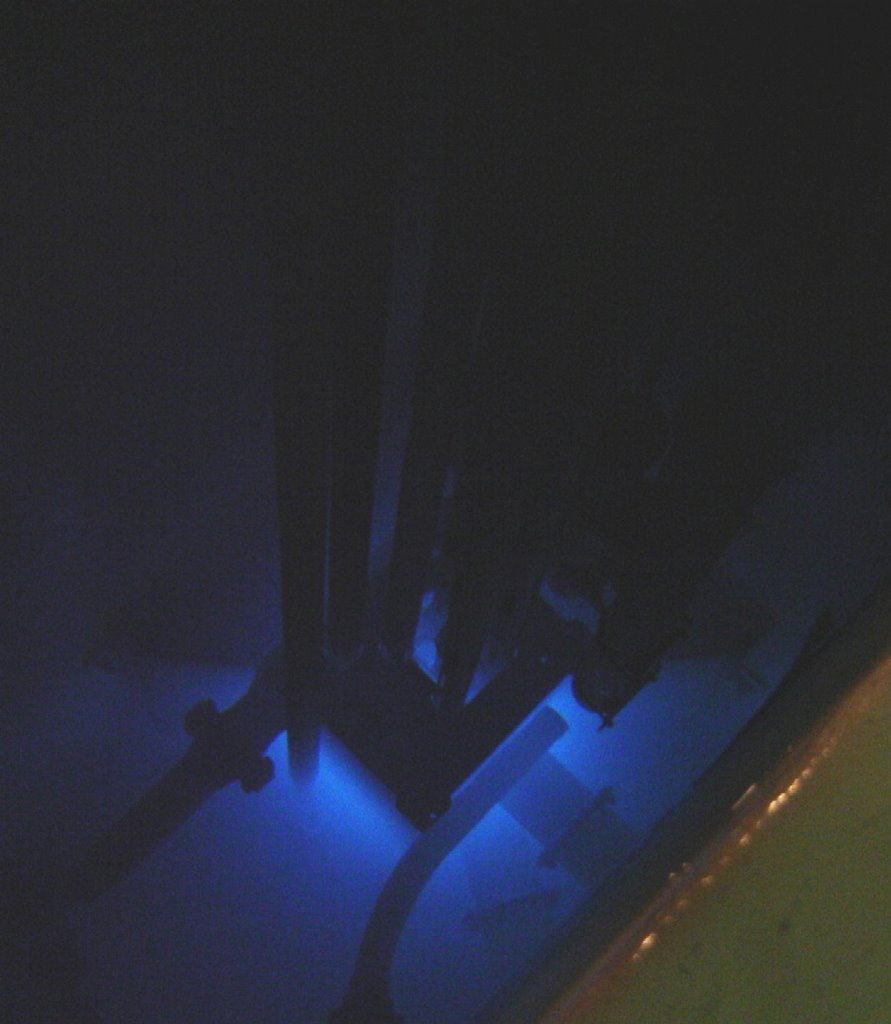
On September 13, 1987, two men broke into the Instituto Goiano de Radioterapia (IGR), a partially demolished private cancer radiation therapy facility, and carted away a 300kg object in the belief they'd a found a valuable scrap metal item. Roberto dos Santos Alves and Wagner Mota Pereira took the object to Alves' home, about one-half kilometer north of the clinic, and began to dismantle it.
Over the next few days Alves and Pereira cut away at the metal exterior and managed to puncture the casing. Despite the fact both men started to become violently ill with vomiting and diarrhea, they continued their efforts, eventually cracking open the device - inside was a smaller metal canister with a movable "window." When the inner canister's window was pried open, it revealed a mysterious blue glow inside the inner shell. The men scraped away and extracted several small chunks of the glowing blue substance within with a screwdriver to keep as "souvenirs."
On September 18th, Alves sold the object to Devair Alves Ferreira, a nearby scrap dealer. Fascinated by the blue glow, Ferreira invited his family and friends over to see and touch the object. Ferreira's brother Ivo brought some of the powder from the canister home and spread it on his floor; innocently, his 6-year-old daughter Leide played with the powder, rubbed it on her skin, and even ingested a small quantity. Over the next several days, she and others who handled the glowing powder fell ill with vomiting, diarrhea, skin rashes, burns, and blisters.
 Now fearing the object was "killing her family," the scrap dealer's wife Gabriela placed it in a plastic bag, boarded a bus, and brought it to the Vigilancia Sanitaria hospital on September 28. One of two doctors who met with Gabriela that day suspected the danger, and placed the bag on a chair in the outer hospital garden, as far away as possible from human contact.
 The following morning, a visiting medical physicist with a borrowed radiation detector confirmed the doctor's fears - the hospital now was massively contaminated with radiation. The physicist, identified only as "W.P." in official reports, initially encountered a great deal of resistance alerting authorities to the severity of the emergency. By the end of the following day, W.P. convinced the Secretary for Health of Goias State and the Director of the Department of Nuclear Installations in CNEN to begin a massive search and cleanup operation in the area.
What Alves and Pereira unknowingly brought home from the abandoned clinic was a lead-shielded cancer therapy device containing a lethally radioactive cesium137 chloride (salt) core. All told, 130,000 people were tested for radiation at area hospitals, about 250 were found to be contaminated, and 20 required treatment for radiation sickness. Several houses within the neighborhood had to be demolished, and the rubble buried in a remote waste site. The cleanup effort also was hampered not only by the length of time that passed since the core was exposed and handled, but also by the fact the radioactive powder was water-soluble.
Four deaths are attributed to direct exposure to the cesium core: Leide and Gabriela Ferreira, and two of Devair Ferreira's scrapyard employees succumbed to radiation poisoning about a month after receiving radiation doses of 4.5 to 6.0 Gy (500 to 600 REM). Leide was buried in a lead coffin surrounded by concrete in a Goiânia cemetery, where crowds protested her burial, fearing their relatives' graves would be contaminated. Remarkably, Devair Ferreira survived his massive 7.0 Gy exposure.
The accident - rated 5 on the International Nuclear Event Scale [INES] - spread radioactive contamination throughout the Goiânia districts of Aeroporto, Central, and Ferroviários. To this date an estimated 7 of the device's nominal 50 TBq (terabecquerels) of radioactivity remain unaccounted for.
Image at top from the IAEA 1988 report on the Goiânia Accident. Lower image, by Alexander Sassaki/SIPA Press appears in "Radiation Accident Grips Goiania," by Leslie Roberts, Science, 1987 (see link below).
- Centro de Exelencia em Ensino, Pesquisa, e Projectos (Brasil, "Center of Excellence in Teaching, Research and Projects"), site of the Associação da Vítimas do Césio 137.
- ArchDaily.com Brasil: new architectural design and rehabilitation plans for Goiania (in Portuguese)
- Pra não dizer...que não falei do Césio-137: from Brazil, focusing on the radiological incident. Very interesting and informative blog, well worth visiting, even if (like me) you need to use Web translation tools for the original Portuguese.
- The NEA's Case Law report that includes the 2000 administrative decision regarding the Goiana Accident (PDF, 10pp.)
- 1102 Blog: The Goiana Radiation Accident
- "The Goiânia Radiation Incident: A Failure of Science and Society," (1988) by Marco Antônio Sperb Leite and L. David Roper (unpublished article, also on Veneer Magazine)
- "Radiation Accident Grips Goiania," by Leslie Roberts, Science (New Series), Vol. 238, No. 4830 (Nov. 20, 1987), pp. 1028-1031. Published by: American Association for the Advancement of Science [JSTOR subscription required]
- New Straits Times (May 7, 1995): "Goiania accident site now a tourist attraction"
- "Reducing the Risk from Radioactive Sources," IAEA SRS Toolkit by Carolyn MacKenzie (PDF, 3pp.)
- IAEA: Goiânia's Legacy, Two Decades On
- [Note: the URL for this video has been changed] On YouTube, you can view an informative 37-minute TV documentary on the Goiânia accident (in Portuguese) as part of the Linha Direta investigative series, hosted by Domingos Mireilles, containing a detailed re-enactment*: Odesson Alves Ferreira, president of Associação da Vítimas do Césio 137, is interviewed beginning at timestamp 4:18.
- IAEA Video: The Legacy of the Goiânia Radioactive Source Accident:
- YouTube video: "Enterro de Leide das Neves Ferreira - Apedrejamento e Vandalismo no Cemitério Parque" ("Burial of Leide das Neves Ferreira - Stoning and Vandalism in Cemetery Park")