Chernobyl Database, which I believe is based in Japan, focuses fairly narrowly on posting papers studying the effects of radiation and radioactive contamination on the environment and health, but it also ventures deeply by including links to research going back several decades. Entries are primarily in English, with separate categories for articles published in Japanese and Russian. I think you'll find it a valuable resource.
Information, Discussion and Links on Radiation, Nuclear Energy and the Atomic Age
Showing posts with label Ukraine. Show all posts
March 26, 2013
Chernobyl Database: A New, Useful Research Tool
Chernobyl Database, which I believe is based in Japan, focuses fairly narrowly on posting papers studying the effects of radiation and radioactive contamination on the environment and health, but it also ventures deeply by including links to research going back several decades. Entries are primarily in English, with separate categories for articles published in Japanese and Russian. I think you'll find it a valuable resource.
Labels:
accidents,
biological vectors,
chernobyl,
containment,
decommissioning,
energy,
environment,
Fukushima,
nuclear policy,
nuclear safety,
radioactive,
research,
Ukraine
November 30, 2012
Chernobyl's New Safe Confinement Rises: The First Stage
After nearly two decades of administrative, political, and financial setbacks, major progress is being made now at the New Safe Confinement. Having been previously called "Ukritye" and the "Shelter Implementation Plan" over the years, the secure NSC outer shell being built over the decaying Chernobyl Sarcophagus will allow Reactor 4 to finally be safely dismantled with greatly reduced risk to the environment.
In the clip below, Vince Novak, the EBRD [European Bank for Reconstruction and Development]'s Director of Nuclear Safety discusses the construction progress and the NSC's benefits.
This video (:35) shows a time-lapse version of the first NSC section's raising.
In the clip below, Vince Novak, the EBRD [European Bank for Reconstruction and Development]'s Director of Nuclear Safety discusses the construction progress and the NSC's benefits.
This video (:35) shows a time-lapse version of the first NSC section's raising.
- April 27, 2012: Construction Begins on New Chernobyl Containment
- 1993 proposal for remediation of the Sarcophagus, Lawrence Livermore National Laboratory [via OSTI.gov, PDF]
- USAID 2006 pledge letter promising American funding for the Chernobyl Shelter Implementation Plan [PDF]
- November 29, 2012 story and photos in World Architecture News
- November 29, 2012 story and photos in RT News
- November 29, 2012 in Pravda
Labels:
accidents,
chernobyl,
containment,
decommissioning,
EBRD,
environment,
liquidators,
New Safe Confinement,
nuclear safety,
nuclear waste,
Pravda,
RBMK,
robotics,
SIP,
Ukraine,
Ukritye
August 06, 2012
"Inside Chernobyl (2012)": A Documentary by Adrian Musto
Much has been said here and elsewhere on the longstanding tragedy of Chernobyl, so I'm always pleasantly surprised to find a fresh look at the topic. Today I discovered a documentary by Adrian Musto, a photographer and filmmaker who also posts under the nom de Web Arkitekture. What's he's created here "on no budget" (in his words) using footage from a recent visit to Ukraine and Pripyat, is remarkable. Beginning with some archival videoclips from the first days of the 1986 accident, the film captures the haunting air of present-day Pripyat, the soon-to-be "New Safe Confined" Sarcophagus, interviews with residents, and some on-the-spot radiation meter readings of objects and structures. I'm sure you'll find "Inside Chernobyl" fascinating. [Note: some of the images may be disturbing to sensitive viewers.]
Musto's photos from Chernobyl, viewable in a gallery on his website, are also stunning. You can listen to some of his Chernobyl trip backstory at Deep Inside Podcast from July 10, 2011, which features very nice atmospheric IDM music from Kiev-based producer Queensway.
Labels:
accidents,
chernobyl,
environment,
New Safe Confinement,
nuclear safety,
Pripyat,
Ukraine,
Ukritye,
videos
April 27, 2012
Construction Begins on New Chernobyl Containment
[5/11/12 UPDATE: the National Radio Company of Ukraine announces that the Chernobyl shelter will be dismantled before 2022 (via NCRU)]
On the 26th anniversary of the Chernobyl disaster, construction began on the long-awaited secondary containment shelter - or "Ukritye" - that will surround the site's crumbling concrete "sarcophagus." From AFP on YouTube:
The Shelter Implementation Plan (SIP) proposed over a decade ago by a multinational consortium languished for years due to a lack of funding; recent major donations have prompted ground-breaking on the project that eventually will cost nearly $1B. From Neue Deutsche Welle:
On the 26th anniversary of the Chernobyl disaster, construction began on the long-awaited secondary containment shelter - or "Ukritye" - that will surround the site's crumbling concrete "sarcophagus." From AFP on YouTube:
The Shelter Implementation Plan (SIP) proposed over a decade ago by a multinational consortium languished for years due to a lack of funding; recent major donations have prompted ground-breaking on the project that eventually will cost nearly $1B. From Neue Deutsche Welle:
Construction on the so-called New Safe Confinement is slated to finish in 2015 and the new shelter will allow experts to dismantle the reactor and clean up the radioactive waste still present. On April 26, 1986, an explosion at the nuclear reactor spewed radiation that winds carried over much of the northern hemisphere with Belarus, Ukraine and Russia bearing the brunt of the fallout. A so-called "sarcophagus" was built over the reactor, however, it has leaked radiation in recent years. Donors pledged 740 million euros ($980 million) to build the new, permanent containment barrier and a nuclear fuel waste facility.A new web resource on the Chernobyl disaster that purports to "[Publish] independent scientifically validated information about the consequences of Chernobyl disaster" can be found at the European Center of Technological Safety (TESEC):
This accident has been used, and is still used, as one of the key element of public mistrust "vis a vis" both the political and the scientific communities. The scale of the material losses and the financial cost of mitigating the consequences of the Chernobyl accident provide compelling evidence of the extremely high price of errors and shortcomings when ensuring the safety of nuclear power plants and of the need for strict compliance with international safety requirements during their design, construction and operation. The accident has convincingly demonstrated that the cost of ensuring the safety of nuclear facilities is significantly lower than that of dealing with accident consequences. Large-scale man-made accidents cause great social and economic damage to countries located in their area of influence. In the spirit of UN Convention on Access to Information, Public Participation in Decision-making and Access to Justice in Environmental Matters (Aarhus Convention) it has been decided to develop and deploy a international scientific network for dissemination and publishing in web site scientifically validated information about the consequences of Chernobyl disaster. The Aarhus Convention was negotiated by the United Nations Economic Commission for Europe as part of its pan-European environmental legal framework. It is generally intended to lift the veil of environmental secrecy and strengthen citizens' environmental rights. The Aarhus Convention aims to ensure that the public has access to this type of information and to prevent Governments from covering up environmental disasters. Web site is address to various categories of targets (public of different levels of education, decision-makers, scientists, associations, governmental authorities and concerned international organizations, etc.).
March 20, 2010
YouTube Video - Chernobyl Disaster, The Severe Days
Were there any other kind? This striking film footage (taken by the late Vladimir Shevchenko, who died of radiation exposure soon after this film was made) was posted to YouTube several years ago, but as we approach the anniversary of the Chernobyl accident, these images show the stunning disregard for radiation protection given to the first responders and "liquidators." They dig, film, and cart away searingly radioactive debris using only conventional work gloves, cloth facemasks, and construction respirators, seemingly unaware or dismissive of the immediate danger they face. Some later web versions of Shevchenko's film have background music added, but I think this silent version with supertitles conveys its potent message best.
Labels:
chernobyl,
radioactive,
Shevchenko,
Ukraine,
videos
April 18, 2006
2005 Report: Safety State of the (Chernobyl) Sarcophagus
There is a new 2005 "Safety State of the Sarcophagus" report available online (9.7Mb PDF) from [Gesellschaft für Anlagen und Reaktorsicherheit] GRS/IRSN [Institut de Radioprotection et de Sûreté Nucleaire], the French-German Initiative for Chernobyl. The free 70-page color booklet contains narrative in French, German, English and Russian; along with photos of the damaged reactor and the surrounding area, detailed accounts of the damage and radiation released in the 1986 accident, and current plans for abating and controlling the deterioration of the current "shell" surrounding Reactor 4.
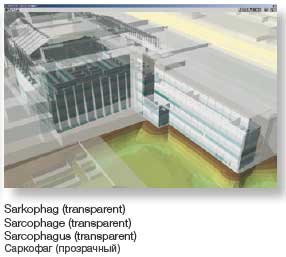
What's new and quite interesting here are recent ArcView GIS [Geographic Information System] and computer-generated 3D maps of the site, many which include environmental radiation level isosurfaces (example from the GRS/IRSN 2005 report shown).
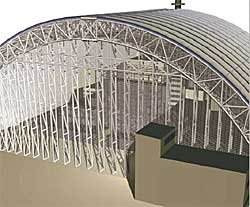
A computer rendering of Chernobyl Shelter 2, shown here, depicts the proposed new external containment structure for the hastily-constructed 1986 sarcophagus, now severely deteriorated by harsh weather and intense radiation. According to the SIP [Shelter Implementation Plan], the goal of building the aluminum semicircular housing is "to safely confine the radioactive materials for at least 100 years and...to allow their retrieval from inside if need be as well as the dismantling of the old structure."
Labels:
chernobyl,
containment,
GIS,
GRS,
nuclear safety,
sarcophagus,
SIP,
Ukraine
Archives: Chernobyl Reactor 4 "Radioactive Volcano"
[Originally Posted May 15, 2004] My search for information on Chernobyl has taken me to some very strange places.
This morning, I found this image on a fascinating Italian Chernobyl website, The Humus Project, or Progetto Humus, at http://www.progettohumus.it [the page this image appears on is here]. Look closely.
I can't verify its authenticity (unfortunately, many of the images lack captions or explanations) but it appears to be a shot of the glowing core of Chernobyl Reactor 4 shortly after the explosion. The timestamp on the image reads 01:23:59. But is it 1:23:59 AM on April 26th, 1986?
Thinkquest Library states that the containment lid of Reactor 4 blew off at 01:23:44 am, while the German 'Society for Plants and Reactor Safety', GRS (Gesellschaft für Anlagen und Reaktorsicherheit, in their technical report "The Accident and Safety of RBMK Reactors" [5Mb PDF file]) places the time of the explosion at:
01:24:00If this photo is genuine, then it would be the first time I've been able to track down an image of the reactor in the earliest stages of the accident. I have not yet found an image of this type anywhere in Chernobyl literature, either on video, in books or and other source. Where did this come from, considering that the former Soviet Union did not inform the outside world of the explosion until days later? Was there a camera trained on the reactor? Did the image come from a flight over the reactor later than the timestamp indicates?
Recording of the shift supervisor: "Strong impacts, the shutdown systems stop before reaching the lower end position ..." Reactor excursion with more than 100 times of the nominal power. Explosion and destruction of the reactor core. The upper plate of the reactor is hurled up, all pressure tubes break off. Core material and burninggraphite parts are ejected. The reactor is burning, further fires start in the surrounding. Massive release of radioactive fission products.
Humus Project Chernobyl Video streams
Google Directory page for Science > Technology > Energy > Nuclear > Safety and Accidents > Chernobyl.
Belarus Guide on Chernobyl Information
Humus Project English version (Progetto Humus, Italy)
February 28, 2006
Chernobyl Children's Project International's "20 Years, 20 Lives" Series
A little while back, I received an email from Kathy Ryan of the Chernobyl Children's Project International, with news about the organization's special web series, "20 Years, 20 Lives":
"...I've been reading your Radioactive blog with interest, and I wanted to call to your attention a series that we recently started running on our website. It is called "Chernobyl: 20 Years 20 Lives" and it is a series of eyewitness accounts in words and interviews of people whose lives continue to be affected by the Chernobyl nuclear disaster...."Thank you for your message, Kathy - I'm very happy to pass on the word, and thank you for all the good work your organization provides to help those affected by the disaster.
Chernobyl – Twenty Years, Twenty Lives is EarthVision's photo journalistic journey through the countries of the Ukraine, Belarus, Russia, Latvia, Sweden, France, and UK. It follows twenty people in their daily lives nowadays and reflects on how they changed after the events of April 1986. The goal of the project is to learn from the history and look at the accident from the present perspective at different levels, both locally and globally. Almost 20 years after the Chernobyl disaster, controversy continues about the true effects of the disaster. Chernobyl Children's Project International believes that the story of Chernobyl can be best told through the eyes of the variety of people who have been affected by the disaster.
...
A photo exhibition with the twenty life stories will tour the world beginning at April 2006. EarthVision is currently seeking exhibition hosts. You can reach EarthVision and learn more about the project at 20lives.info.
Labels:
chernobyl,
Chernobyl Children's Project,
photos,
Ukraine,
videos
December 08, 2005
Chernobyl News: Resettlement, More Tourism, and Removal of Nuclear Fuel from Closed Reactor Units
Crews have begun dismantling the remaining nuclear fuel stockpile from the closed reactors at Chernobyl, including the only recently-decommissioned Reactor 3 (the unit involved in the 1986 explosion was Reactor 4). From the Seattle Post-Intelligencer, via AP:
KIEV, Ukraine -- Experts have begun unloading radioactive fuel from one of the closed reactors at Ukraine's Chernobyl nuclear power plant, the plant said Tuesday.In other Chernobyl news, Pravda reports the Ukraine is seeking to boost national revenue by offering more tours of the ravaged Exclusion Zone to foreign travelers, and RIA Novosti News says Ukrainian president Viktor Yushchenko has instructed Kiev officials to begin legalizing the homes of squatters who have moved in the area without permission.
Reactor No 3. - the last to continue operating - was closed for good in 2000, but it was never emptied of fuel. The remaining fuel in reactor No. 3 and reactor No. 1 made it impossible to start construction of a new shelter over the fourth reactor, destroyed in the 1986 explosion and fire that spewed radiation over much of northern Europe.
In an effort to prevent further radiation release, engineers hastily erected a concrete-and-steel shelter over the damaged reactor, but parts of it are crumbling, and a new shelter is needed. Originally officials had planned to unload the remaining fuel into a new storage depot, but plans for its construction were suspended until 2010. The plant's spokesman, speaking on customary condition of anonymity, said the fuel will instead be unloaded into a Soviet-era used fuel depot. Unloading the fuel, which began Monday, is necessary to make the plant entirely inoperative, Chernobyl staff said.
Labels:
chernobyl,
decommissioning,
nuclear,
nuclear safety,
Pravda,
Ukraine,
Yushchenko
August 16, 2004
More Nuclear Troubles in the Ukraine
Australia's Herald Sun reports of serious problems last week at the new Khmelnitsky nuclear power plant at Neteshin:The reactor at Khmelnitsky power station had to be shut down on Sunday, less than two hours after it went into operation, Interfax news agency reported on yesterday. Further technical failures prevented it operating on Monday and Tuesday.Not an auspicious beginning, I'm afraid, despite ITAR-TASS' rather glowing (if spoken-too-soon) praise. I truly hope plant officials don't do something silly...like deciding to bypass safety measures to "get the thing started" - we know where that can lead.
"These incidents do not represent any threat to the public or to the environment," state nuclear energy company Energoatom said in a statement.
Ukraine was the scene of the world's worst civilian nuclear disaster in 1986, when a reactor at Chernobyl nuclear power station exploded, contaminating large areas in Ukraine and neighbouring Belarus and Russia. Energoatom confirmed incidents had occurred at Khmelnitsky but said it "saw no cause for concern".
"Certain media inflated the affair," it said.
The K2 Russian-designed VVER pressurised water reactor at Khmelnitsky, which has a capacity of 1000 megawatts, was brought on stream on Sunday at a ceremony attended by Ukrainian President Leonid Kuchma. But it ground to a halt almost immediately.
An official at Ukraine's governmental commission for atomic energy said that automatic security systems at the power plant had cut off the reactor from the electricity grid. The reactor was reconnected to the grid three hours later but had to be totally shut down later because of a failure in the cooling system caused by a power breakdown, the official added.
The reactor was restarted on Monday, only to be stopped again yesterday, officially to test its shut-down system and cooling units.
Frighteningly, for many regions of the world like Ukraine, nuclear energy is currently one of the most viable energy options. Having a cold climate with existing high pollution, more use of fuels like coal would cause further damage to air quality and likely increase rainfall pH levels. Additionally, research into developing workable technologies such as geothermal, solar and wind power requires large-scale financial investment that strapped nations like the Ukraine simply can't afford.
From "Non-traditional sources of energy may be key to Ukraine's future," by Roman Woronowycz of Kyiv [Kiev] Press Bureau, in the Ukraine Weekly, April 30, 2000:
Once looked at with keen interest, a Ukrainian government choked by money shortages has cast aside any serious work on the development of non-traditional renewable energy sources, such as wind and solar power, as an alternative to its primary reliance on atomic energy.More than any other nation, the Ukraine should understand the risks of nuclear power and the awesome consequences of "inconsequential" mistakes - but with another bitter winter on the way, time manages to dull the sting of fear almost as smoothly as reassuring official words. "If someone you know was killed in a car crash nearly twenty years ago, would you stop riding in cars for the rest of your life?"
Ukraine has made much of the West's delays in providing financing to complete two traditional and controversial new reactors that Kyiv wants completed to offset the power that will be lost when Chornobyl shuts down at the end of this year. However, there are those here and in ecologically minded countries such as Germany who believe that Ukraine has no recourse but to reconsider non-traditional energy sources as well, which could do the work of the nuclear power plants as efficiently and with none of the risk.
One such person is the institute's director, Viktor Shulha, a gray-haired, 60-something scientist with a strong belief that Ukraine must turn to wind and solar power to meet its energy demands. Mr. Shulha said he has been frustrated in his attempts to turn the government's ear to his cause by the most familiar of laments in Ukraine: there simply is no money for it.
Mr. Shulha became the director of the Institute of Energy Engineering when it was formed 10 years ago by the Ministry of Energy, and at one time had an extensive group of advisors and experts. The team already had developed recommendations and a plan for developing wind energy when it came up against the insurmountable wall of Ukraine's current economic reality.
"We decided that for Ukraine the best potential would be to develop wind and biomass sources, and the government put the accent on wind energy. But, as it turned out, Ukraine had no finances and the experts moved on," said Mr. Shulha.
Atomic technology has advanced since the 1986 disaster as wealthier nuclear-dependent nations, like France, Belgium and Italy, have invested considerable sums in developing safer meltdown-resistant reactor designs. Nonetheless, as history has shown, nothing is truly 100% foolproof - and make no mistake, EnergoAtom is a beleaguered interest, by any account [check out news stories linked below]. Let's keep our fingers crossed, and our orbiting Eyes In The Sky watchful.
EnergoAtom's website
EBDR Loan to EnergoAtom Agency of Ukraine [July 21, 2004]
September 13, 2002 Weekly Mirror ["Zerkalo Nedely"]: "COURT RULED: NEDASHKOVSKY MUST RETURN TO HEAD ENERGOATOM"
WISE/NIRS Nuclear Monitor, October 18, 2002, "Scandals and lawsuits face Ukraine's Energoatom"
Labels:
ENERGOATOM,
energy,
nuclear safety,
reactors,
Ukraine
June 24, 2004
Chernobyl Explorer: Alexander Borovoi
Dr. Alexander Borovoi is one of the people interviewed (his segment starts at 32:40) in this astounding BBC documentary from 1991, "Inside Chernobyl's Sarcophagus." Borovoi and his colleagues Viktor Popov, Yuri Buzulukov, and other "Stalkers" speak with western journalists for the first time since the accident. The scientists and BBC crew enter the Reactor 4 building taking measurements and video footage of its wreckage, in extreme haste (due to the radiation levels) and incredibly dangerous conditions. Footage had to be shot by actual cameramen working quickly, as the searing radiation and rough ground caused robotic camera rigs to mire or fail within minutes. In one segment we see a clever improvisation: the team jerry-rigged a small videocamera onto a wire remote-controlled child's toy tank. The end of the documentary is an interview with Borovoi and Popov five years later, where we revisit their dire predictions, and the surviving members of the "bio-robot" team.

[UPDATE: Borovoi's 2008 presentation detailing the state of the Chernobyl corium, or "melt." (PowerPoint on SarNet.org] 64-year old Alexander Borovoi is a brave man, and a very lucky one; he is one of the "extreme explorers" who periodically examined the inside of the Chernobyl sarcophagus to spot developing problems. From US News and World Report:

[UPDATE: Borovoi's 2008 presentation detailing the state of the Chernobyl corium, or "melt." (PowerPoint on SarNet.org] 64-year old Alexander Borovoi is a brave man, and a very lucky one; he is one of the "extreme explorers" who periodically examined the inside of the Chernobyl sarcophagus to spot developing problems. From US News and World Report:
The line between hero and victim was thin in the first frantic weeks after the accident. Firemen fought the flames but lacked instruments to tell them they faced lethal doses of radiation. Military helicopter pilots hovered in the radioactive smoke plume to smother the burning reactor with tons of sand and lead, but their bombing runs missed the mark.
Yet the catastrophe–and the chance for heroism–did not end when the fire burned out. In the months and years that followed, a band of scientists led by physicist Alexander Borovoi explored the reactor's corpse to make sure it could not reawaken. Working in a hot, dark labyrinth where lingering radiation could kill within minutes, they mapped and analyzed tons of reactor fuel remaining. It was heroism of a quieter and more effective order than had come before. "Borovoi knew what he was doing," says Harvard University nuclear physicist Richard Wilson, "and he had the imagination and common sense" to succeed.
To find the remnants, Borovoi and his men had to venture into the heart of the destroyed reactor. Robots were not up to the job; they got stuck in debris or ran amok, circuits scrambled by radiation. "We had only one kind of robots [that worked]," says Borovoi. "Biorobots–ourselves." They called themselves "stalkers." Coveralls, gloves, and a respirator were their protection–lead suits were too bulky for dashes through the reactor. A fall or wrong turn could be fatal.
Late in 1986, beyond a gantlet of highly radioactive rooms and narrow passages, the stalkers discovered a glassy, black formation resembling a giant elephant's foot. Getting a piece to analyze was not easy. It was so fiercely radioactive that the scientists could spend only seconds near it, and its surface shrugged off a drilling machine and an ax. Finally a marksman took aim with a Kalashnikov rifle. The shards gave the first clues to what had happened to the nuclear fuel and the chance of a future catastrophe.
[read full article]
Labels:
accidents,
BBC,
bio-robots,
Borovoi,
Buzulukov,
chernobyl,
Elephant's Foot,
liquidators,
nuclear waste,
Popov,
robotics,
Ukraine,
videos
May 04, 2004
18th Anniversary of the Chernobyl Disaster
They say there are no coincidences in life.
Today - on the precise anniversary of the Chernobyl disaster - I received my first completely trashed Amazon.com shipment (which I returned tout suite). I ordered VHS tapes of two ABC Nightline special reports on the incident: Chernobyl Nuclear Disaster (aired April 28th, 1986, when the West first heard of the reactor accident) and Chernobyl Plant - The Aftermath (aired April 22, 1987). Since I didn't pay Chernobyl much mind in 1986, I thought the archival program footage would be fascinating (seeing a young Ted Koppel is always good for a chuckle).
I'm sure it will be when the replacements arrive. The shipment I received today appeared to have been either run over by a car or stepped on by Ruben Studdard: the box was accordioned into a hourglass shape, and I knew it was bad news when I shook it like a Christmas present. Rattle, rattle, ching. The tapes inside were literally smashed into black plastic shards. Sigh. Neeeeext! We'll see if Amazon holds to their reportedly strong returns policy.
And, the news breaks that the Vermont Yankee nuclear power station in my old neck of the woods "lost" two pieces of highly radioactive spent-fuel rod:
From USA Today:Burlington, VT's WPTZ-TV today reports that the missing pieces are, well, still missing. I don't live near Burlington these days, but that doesn't make me feel much better. It's like hearing that your downstairs neighbor's pet Black Mamba turned up missing.
The operators of the Vermont Yankee nuclear power plant reported the missing pieces Wednesday, saying they were not where they were supposed to be in the large pool used to store fuel rods. One of the missing pieces is about the size of a pencil. The other is about as thick but is 17 inches long.
The spent fuel rods are highly radioactive and would be fatal to anyone who came in contact with them without being properly shielded, Nuclear Regulatory Commission spokesman Neil Sheehan said. Spent nuclear fuel could be used by terrorists to construct so-called dirty bombs that would spread deadly radiation with conventional explosives.
"We do not think there is a threat to the public at this point. The great probability is this material is still somewhere in the pool," Sheehan said. The pieces could also have been sent years ago to a testing laboratory or a low-level nuclear waste disposal facility. The pieces were part of a fuel rod that was removed in 1979 from the Vermont Yankee reactor, which is currently shut down for refueling and maintenance.
So, my research into Chernobyl (which includes scouring the Web and government sites, and the University of Chicago and Harold Washington Libraries) has been slightly delayed. However, for the curious, I have a selection of choice hand-picked links that will provide multi-national insights into the incident, and its continuing aftermath.
The German nuclear-safety agency GRS [Gesellschaft für Anlagen und Reaktorsicherheit, mbH] has a well-illustrated, informative 179-page free online technical report called "The Accident and the Safety of RBMK Reactors" [large PDF file, 5Mb].
If you enjoy government reports and "blue books," visit the World Nuclear Association's Chernobyl page, which includes links to UNSCEAR [United Nations Scientific Committee on the Effects of Atomic Radiation, which published several comprehensive reports on the Chernobyl disaster - many which are available here as free PDF downloads.
Watch This: Chernobyl.co.uk, a UK site which features a link to the BBC's recent 30-minute program [streaming RealPlayer video] on Chernobyl, featuring a look at the history of nuclear power in the former Soviet Union as well as a look inside Ukraine's Exclusion Zone towns. Highly recommended: this program illustrates that the deteriorating reactor site is still an issue of pressing concern through Europe, while it has been all but overshadowed here in the U.S.
Watch This: though the bulk of Chernobyl news coverage occurred before the age of streaming video, the post-date digitized BBC retrospective of the Chernobyl disaster [RealPlayer required] is a wistfully immediate - if lo-res - look back at those fateful days in April 1986.
Ukrainian biker gal (and young scientist) Elena is the Kidd [sic] of Speed: her wildly popular site, Ghost Town, features dozens of startling photos and rueful, blustering commentary from her motorcycle tour through the post-apocalyptic Exclusion Zone in Pripyat': part National Geographic expedition, part Jackass-meets-Evel Knievel. Strange thing is, I'd probably do it too, given the opportunity and a lead X-ray apron - but I'd prefer an enclosed vehicle, like a Bradley.
Got Euskadi? The Basque Website of Pripyat.
Have Paris, Rome, and the Caribbean lost their appeal? Been there, done that? How about a guided group tour through Chernobyl? I don't know if it's a legitimate enterprise, but you can apparently book a tour through the Exclusion Zone via Ukrainian Web Chyornobyl' Tour. You get complimentary disposable outerwear and shoes, and a souvenir computerized dosimeter printout that certifies how much radiation you absorbed during your visit.
The Jet Propulsion Laboratory's Pioneer Robot pages, with photos and diagrams of the Red Zone Robotics radiation-hardened explorer robot that will be used to excavate and explore the hot ruin inside the Sarcophagus.
A recent Kazakhstan Kazinform press release from March, 2004, warning that trouble at the Chernobyl Sarcophagus could be imminent.
From a nation that is also highly dependent on nuclear energy, but has thankfully suffered neither a Chernobyl nor a Three Mile Island type incident - the Canadian Nuclear Association's report on Chernobyl.
USGS satellite photos showing changes in the Chernobyl region from 1986 to 1992.
An August, 1986 EPA Bulletin on short-term American response to the Chernobyl disaster.
Gla55pak.com has compiled some unusual Chernobyl images here, and proclaims "I have a sick curiosity - more of an impulse - to be there that night and watch the thing light up. I would gladly take a good dose just to have seen it. It is, after all, like an immense train wreck that I just can't help but see." Also: link to Disenchanted.com's take on the Chernobyl and TMI incidents, called "Fear's just bad for business".
A high-resolution satellite image of the Chernobyl region from the Jet Propulsion Laboratory, suitable for desktop backgrounds.
Some of the best photos of the site I have seen are on the INSP's [International Nuclear Safety Program] Digital Library Website, where you can view over 800 color and black-and-white images, including the one at the top of this post.
Labels:
accidents,
chernobyl,
nuclear,
nuclear safety,
Ukraine
Subscribe to:
Posts (Atom)