Showing posts with label chernobyl. Show all posts

April 08, 2013

"Exposure: Radiation Victims Speak Out" Web Series Reveals Personal Struggles, Triumphs

Over 20 years ago, the Hiroshima newspaper Chugoku Shimbun sent a team of reporters to 15 nations around the world to gather personal accounts of people affected by radiation - from reactor accidents, accidental contamination, to nuclear weapons manufacturing and testing. The interviews were initially published as a series of eight newspaper features titled "Sekai no Hibakusha," or "Hibakusha (figuratively, "atomic bomb survivors") Around the World." This monumental series won a Japan Newspaper Publishers and Editors Association award in 1990, and was subsequently published in book form the following year. Executive Director of the Chugoku Shimbun Yukio Ogata explains,
"Largely as a result of the articles' success in bringing the public's attention to the dangers of radiation, a number of victims of radioactive contamination from areas as far-flung as Chernobyl and Bikini Atoll were able to participate in the world convention held in Hiroshima by the International Physicians for the Prevention of Nuclear War in October 1989...[T]he convention heard details concerning the damage caused by nuclear testing in Kazakhstan, which until then had been shrouded in secrecy. In turn, this disclosure of widespread destruction of the environment prompted the Chugoku Shimbun to instigate the first-ever investigation of the testing area.

At the same time, the articles served to emphasize the role that Japan could play to help radiation victims around the world. The fact that the articles have prompted the exchange of information concerning the treatment of radiation victims in Japan to help those in a similar plight in other countries is a great source of satisfaction to us at the Chugoku Shimbun. We hope that, in the future, Japan will become known as an information center for radiation victims and the treatment of their illnesses."
In March 2013, the Hiroshima Peace Media Center re-released the entire series of 134 interviews free online as "EXPOSURE: Victims of Radiation Speak Out". From the English-language introduction by Dr. Robert Jay Lifton, Director of the Center on Violence and Human Survival at the CUNY John Jay College of Criminal Justice notes,
"There is compelling appropriateness in the project's being undertaken by concerned journalists from Hiroshima. From the time the bomb was dropped, the Chugoku Shimbun, as Hiroshima's leading newspaper, has been a prime source of information about the experiences and feelings of the people of that city over subsequent decades. Its editors and writers have taken on what I call a 'survivor mission' on behalf of the city's victims, a commitment to transforming the fear, conflict, and pain of the survivors into an active exploratory enterprise of profound significance.

Their contribution goes even beyond their descriptions of the human effects of radiation. In the way they have approached their study, they have demonstrated what I call a species mentality, a commitment that transcends immediate group or nationality and extends to all of humankind. They evoke in us a sense of shared fate, of universal susceptibility to a technology that knows no boundaries, geographical or temporal. We are all in this together, as potential victims and potential perpetrators as well.
Among the regions and incidents covered in these interviews are Chernobyl, the 1987 Goiânia Accident in Brazil, contamination from the Cold War weapons program at Semipalatinsk, Kazakhstan, and the Hanford Nuclear Reservation site in Washington State.

[Image courtesy Hiroshima Peace Media Center: "The mushroom cloud as seen from Kure, approximately 18 kilometers southeast of Hiroshima. This photo was taken by Masami Oki about 40 minutes after the bomb exploded."]

More:

March 28, 2013

Radioactive Wild Boars Found in Northern Italy

The Italian newspaper Corriere Della Sera reports that traces of cesium-137 contamination have been found in dozens of wild boars taken by hunters in the northern Valsesia [Sesia Valley] forests, in the province of Vercelli.
[27 A]nalyzed samples of [the] tongue and diaphragm of animals slaughtered during the hunting season 2012/2013 [showed] level[s] of Cesium-137 higher than the threshold specified by Regulation 733 of 2008 as the tolerable limit in the event of a nuclear accident. According to the deputy of the Piedmont Region, Roberto Ravello, alarmism should be avoided because the health risks would be "contained and controlled."
According to Elena Fantuzzi, head of the Institute of Radiation Protection ENEA, the most immediate explanation is that the contamination originated from the 1986 Chernobyl accident. However, she cautions, (translation via GoogleTranslate) "[W]e must also consider the nuclear sites in the area, including the central Trino Vercellese ["Enrico Fermi" nuclear plant] dismantled in 1987 and the experimental site Enea, in Saluggia...[We can not exclude] the trail of toxic waste." Gian Piero Godio, a nuclear expert in the Legambiente Piemonte and Val d'Aosta region adds, "[There may be o]ther explanations....the district of Valsesia has no radioactive source[s]." More: Video news story (in Italian)

March 26, 2013

Chernobyl Database: A New, Useful Research Tool

While having much of the Internet at one's disposal through search engines is a wonderful thing - especially when you know what you're looking for - specialized blogs like the new Chernobyl Database (launched February 2013) also serve a vital purpose: they can help point you in the direction of new research studies and findings you may have been unaware of.

Chernobyl Database, which I believe is based in Japan, focuses fairly narrowly on posting papers studying the effects of radiation and radioactive contamination on the environment and health, but it also ventures deeply by including links to research going back several decades. Entries are primarily in English, with separate categories for articles published in Japanese and Russian. I think you'll find it a valuable resource.

November 30, 2012

Chernobyl's New Safe Confinement Rises: The First Stage

After nearly two decades of administrative, political, and financial setbacks, major progress is being made now at the New Safe Confinement. Having been previously called "Ukritye" and the "Shelter Implementation Plan" over the years, the secure NSC outer shell being built over the decaying Chernobyl Sarcophagus will allow Reactor 4 to finally be safely dismantled with greatly reduced risk to the environment.

In the clip below, Vince Novak, the EBRD [European Bank for Reconstruction and Development]'s Director of Nuclear Safety discusses the construction progress and the NSC's benefits.


This video (:35) shows a time-lapse version of the first NSC section's raising.

August 06, 2012

"Inside Chernobyl (2012)": A Documentary by Adrian Musto

Much has been said here and elsewhere on the longstanding tragedy of Chernobyl, so I'm always pleasantly surprised to find a fresh look at the topic. Today I discovered a documentary by Adrian Musto, a photographer and filmmaker who also posts under the nom de Web Arkitekture. What's he's created here "on no budget" (in his words) using footage from a recent visit to Ukraine and Pripyat, is remarkable. Beginning with some archival videoclips from the first days of the 1986 accident, the film captures the haunting air of present-day Pripyat, the soon-to-be "New Safe Confined" Sarcophagus, interviews with residents, and some on-the-spot radiation meter readings of objects and structures. I'm sure you'll find "Inside Chernobyl" fascinating. [Note: some of the images may be disturbing to sensitive viewers.]


Musto's photos from Chernobyl, viewable in a gallery on his website, are also stunning. You can listen to some of his Chernobyl trip backstory at Deep Inside Podcast from July 10, 2011, which features very nice atmospheric IDM music from Kiev-based producer Queensway.

June 11, 2012

"Lessons Learned from 'Lessons Learned': The Evolution of Nuclear Power Safety After Accidents and Near-Accidents" (AAAS monograph, 2012)

Continuing our theme of our evolving understanding of nuclear power safety, I'd like to highlight an excellent - and timely - paper just released by the American Academy of Arts and Sciences, "Lessons Learned from 'Lessons Learned': The Evolution of Nuclear Power Safety after Accidents and Near-Accidents," by Edward D. Blandford and Michael M. May. From the preface:
"As countries struggle to meet the electricity demands of their growing populations while also reducing their carbon footprints, many have turned to nuclear energy. The U.S. nuclear energy program may not increase significantly in the coming decades, but other countries, including many developing countries, have plans for rapid expansion. Even after the recent accident at the Fukushima Daiichi Nuclear Power Plant in Japan, the global trend toward expansion of nuclear energy has continued.

While serious accidents like Fukushima, Three Mile Island, and Chernobyl can provide invaluable lessons, the nuclear industry, nuclear regulators, and the research community must study minor incidents and near-accidents as well. These experiences often reveal not only how to decrease the likelihood that the same mistakes will occur, but also how to avoid larger accidents that may be foreshadowed in earlier, smaller incidents.

In this paper, Edward Blandford and Michael May enumerate the lessons from nuclear accidents and incidents, asking whether the nuclear energy community has indeed learned from those lessons. The authors argue that stakeholders must commit to ongoing improvement of their protocols and standards. Each nuclear incident—no matter its size—underlines the importance of pursuing high standards of safety, security, and proliferation resistance."
One standout key finding in "Lessons Learned..." is on page 23, in Table 1, "Main Sources of Electricity in the World and Their Morbidity and Greenhouse Gas Emissions Per Unit of Electricity Produced." The authors find that while nuclear energy is the fourth most prevalent form of electricity generation worldwide (at 14% of global usage), it is associated with the lowest number of deaths per terawatt hour (0.04). The least common form of generation, wind power (< 1% of global usage), somewhat surprisingly has a morbidity rate of 0.15 deaths per terawatt hour, but I suspect many of these might be a result of accidents involving installation or maintenance of the wind turbines, rather than the operating process itself.

If you're pressed for time, the paper's executive summary provides an informative primer on its conclusions and policy recommendations for the industry. The paper is available as a free PDF download as part of the AAAS' Occasional Papers series at http://www.amacad.org/publications/lessonsLearned.aspx, or as hard copy for a nominal fee from the AAAS.

June 08, 2012

RadioActive! Classic: Chernobyl Requiem - May 2004

[Originally published May 4, 2004. I'm working on a follow-up version that will examine how things have changed in the intervening years. - LR]

I'm still not certain what triggered it, but this weekend I started thinking about the Chernobyl disaster. True, it's a strange topic to suddenly become interested in, and I can't pinpoint any precipitating cause, such as a news story or random overheard conversation.

Considering that I had a major obsession with nuclear war back in the mid-1980's, I've been rather nuke-phobia-free for the last twenty years or so. The truth is, when Chernobyl's Reactor 4 exploded on April 26th, 1986, I don't remember being horribly concerned or glued to the television for news on the event. This can probably be explained by the fact that I was 18 at the time, and current events were rarely the stuff of daily obsession for me then. I think the zenith of my nuclear paranoia came in 1984 (Coincidence? We think not!), when my high school classes were periodically interrupted with fallout drills and regular lessons on Civil Defense Emergency evacuation procedure.

You see, I lived in Plattsburgh, New York back then - home to Plattsburgh Air Force Base, which was a prominent Northeast strategic ICBM target. What we were all told back then was basically that when the Russkies finally pressed the Big Red Button (of course, it would always be the Russkies pushing the button first), our immediate response should be to duck down under a table or desk, away from glass windows, place our heads protectively between our knees, and kiss our arses goodbye.

Between Ronald Reagan's regularly televised polemics, the "star wars" defense initiative, the Plattsburgh Yellow Pages' obligatory section on Civil Defense evacuation procedures (complete with maps where we should assemble with a change of warm clothing, canned food, jugs of clean water and prescription medications within ten minutes from when we first heard the alarm sirens, preparing to be bussed to safe locations before the Big One hit PAFB in 30 minutes - that's how long it would take the Russkies' ICBM's to strike our little air base) and songs like '99 Red Balloons' by Nena, 'Distant Early Warning' by Rush, 'Dancing With Tears In Our Eyes' by Ultravox (and many others) blaring sweaty repressed fear with a synth-and-guitar backbeat, I had recurring nightmares about nuclear war at least once a week back then.

Every time I heard a fire station call siren, I thought it might be The Big One. It got to the point that when I saw a flash of lightning to the eastern horizon, for a moment my heart skipped and I wondered whether my 30-minute timer had begun.

Sounds crazy, but those were crazy times. Who new that less than two years later, hell would break loose in the Ukraine, with a near-unstoppable radioactive fire spewing toxins into the Northern hemisphere upper atmosphere for nearly two weeks?

Compounding the Chernobyl event's mystery was the Soviet government's complete media silence about the accident for two days, only admitting to the disaster after a Swedish ambassador implored Moscow for answers why incredibly high levels of radiation were being detected in the Scandinavian nation for no apparent reason. Soon images of the reactor inferno reached the outside world, with accounts of brave, desperate virtually unprotected firefighters and helicopter pilots on suicide missions, struggling to put down the graphite moderator fire; the coverage near operatic in its dangerous grandeur and human pathos, a Götterdammerung of man against the mighty Atom unchained.

This past Sunday I heard a dark, minor-key Russian choral hymn on WBEZ, a Chicago classical music station, and in my mind I played over the images of the Chernobyl cataclysm I'd recently seen and read: the juxtaposition made me well up with emotion. Now, for the past few days' I've been researching the entire Chernobyl incident - historical footage and media coverage, and regular updates prepared by regulatory agencies and multinational consortiums, including those who plan to clean up the entombed reactor and rebuild a more permanent protective shield than the hastily-constructed, crumbling Sarcophagus.

I've discovered that the Chernobyl story is far from over: the monster only sleeps. Authorities in the former Soviet Union publicly decried their population's fear of Chernobyl's fallout as "radiophobia," a mass hysteria with no basis in fact. Unfortunately, when authorities are less than candid about the facts, people will try to read between the lines and fill in the blanks, often creating mass panic. Today, a number of nations are scrambling to raise funds to finally contain and clean up the reactor ruin, to dissect its poisonous innards before it wakes, stirred up by seismic activity, weathering, or other events. This project is called the Shelter Implementation Plan, or SIP [PDF file].

Perhaps the recent look back at Chernobyl is no coincidence. Here in Chicago's Hyde Park, just a few yards from where I work, is a large brass Henry Moore sculpture that looks vaguely like a deformed hollow skull, or a mushroom cloud. It stands at the former site of the University of Chicago's Stagg Field, where on December 2, 1942, a researcher named Enrico Fermi created the world's first controlled self-sustaining nuclear reaction. The sculpture is called "Nuclear Energy", and it marks the place where the power of the atom first emerged in the world of man; if not for this event that took place near where I pass every day, there would have been no Hiroshima, no Nagasaki, no Three Mile Island, and no Chernobyl. As Prometheus stole fire from the gods, so Fermi stole the fire of the atomic pile: nuclear energy may certainly have brought some benefits to humankind, but at a rather steep price with compounded interest.

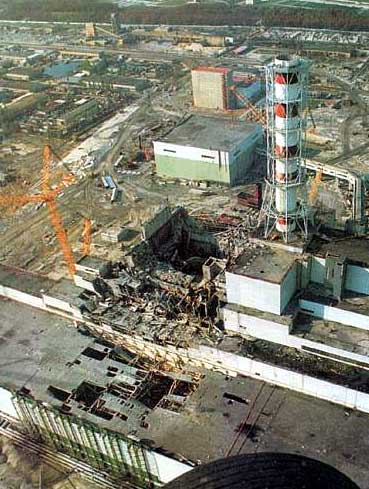
NOTE: The photo at the top of this post is a rare excellent shot of the destroyed reactor after the fire was put out - but before the Sarcophagus was constructed. I found it on the Chernobyl Tour site, where you can apparently book a tour of the area, including stops near the reactor and the neighboring ghost town of Pripyat. Tourists get special disposable clothing and respirators for the trip, and a complimentary computerized souvenir dosimeter reading (unfortunately, I'm not joking). Sorry, no photos allowed by Ukrainian law, which would explain the relative dearth of good images of the accident site available. However, some photos do appear on the Web, mostly from Ukrainian residents who visit the area and some from foreign press visits, which I'll be offering links to in the forthcoming special farkleberries feature on the Chernobyl accident anniversary. April 26th, 1986.

The photoessay site "Ghost Town", created by a young Ukrainian woman named Elena, has received over 2.5 million hits as of this writing; you'll find dozens of startling, one-of-a-kind images of the Chernobyl region accompanied by Elena's account of her visit. While access is strictly limited, Elena states that her father works for the government, and was able to arrange a permit for her motorcycle visit. Thank you, Walt, for this excellent link.

18 years is nothing in the life of a plutonium atom.

May 04, 2012

The "Chernobyl Diaries" Movie: Cultural Amnesia?

On May 25th, Warner Brothers will release a science fiction/supernatural horror film set in Pripyat, the abandoned "ghost town" adjacent to the ruins of Chernobyl's reactor complex. The crumbling town, seen for years on sites like "Kidd of Speed," seems a perfect backdrop for fright flicks. Let me say at the outset that I'm a huge movie fan: cheesy, gory horror flicks are some of my favorites. That said, as someone who was profoundly affected as a college freshman by live unfolding news accounts of Chernobyl (in fact, those memories are one of the main reasons I started this blog back in 2004) I have to admit I find the film's concept a bit troubling and distasteful.

I suspect the primary target audience, if not the filmmakers themselves, probably view the Chernobyl tragedy as just another creepy historical footnote, something awful that happened a long time ago in a country far away. With popular video games like "Stalker: Shadow of Chernobyl," and the film's central premise of "extreme tourism" into the Exclusion Zone, Chernobyl's legacy has mushroomed (if you'll forgive the expression) into a booming cottage industry of curiosities for the "zombie apocalypse" crowd.

Since the nuclear strikes on Japan in World War II, popular culture from 50's Pulp and Godzilla to the Hulk and Spiderman have conflated nuclear mishaps with Bug Eyed Monsters. But I wonder: would movie executives and audiences respond favorably to a zombie apocalypse tale set in a different contemporary locale - say, the Japanese Tsunami of 2011 and the Fukushima Disaster? The Union Carbide Disaster in Bhopal, India? Hurricane Katrina? The terrorist attacks of 9/11?

The passage of time always seems to be an insulator against troubling memories; the human race couldn't survive otherwise. What's sad is that if nothing else, "Chernobyl Diaries" highlights how a mere two-and-a-half decades can generate cultural amnesia of the immense sacrifice and suffering that occurred in Europe and that continues to this day. Thinking charitably, maybe any kind of attention to the Chernobyl tragedy could generate a resurgence of interest in the continuing human need there; after all, they say there's no such thing as bad publicity.

Perhaps the least the makers of "Chernobyl Diaries" could do is donate a portion of their profits to one of the many charitable organizations that provide ongoing support to Chernobyl's victims, many born decades later. Those who were there and survived live with scarred minds, hearts, and/or bodies: every living being born in the afflicted region since April 26, 1986 will carry Chernobyl's memory into the far distant future.

[UPDATE: At least one other film, "Return of the Living Dead 4: Necropolis" was purportedly set in the Chernobyl area; but marketing was fairly low-key and the studios seemed to end up downplaying the Chernobyl connection.]

April 28, 2012

Atomic Age II Fukushima Symposium, May 5th, 2012

RadioActive! readers near Chicago: the University of Chicago, the birthplace of the first controlled nuclear chain reaction, hosts Atomic Age Symposium II - Fukushima, this Saturday, May 5th.
[K]eynote speakers are Hiroaki Koide of the Kyoto University Reactor Research Institute, who has been speaking out against nuclear power for over 40 years; and Ruiko Muto, an anti-nuclear activist based in Fukushima and a member of a citizens’ group, Hairo [Reactor Decommission] Action Fukushima. Robert Rosner, Astronomy & Astrophysics & Physics, University of Chicago (former Director of the Argonne National Laboratory) will share his stance on nuclear energy via a videotaped message. Ruiko Muto’s speech will be followed by Bobbie Paul, Executive Director of Georgia WAND—Women’s Action for New Directions, Jeffrey Patterson (MD, Board Member and Past President of Physicians for Social Responsibility), and Dean Wilkie, a retired nuclear plant operator and manager who, with Nancy Foust, an online media expert, has collaborated on the Simply Info website to provide detailed information about Fukushima.
This will be an all-day symposium investigating the multiple dimensions of the ongoing Fukushima nuclear disaster through discussion by experts from Japan and the US, Saturday, May 5, 2012: 8:45am–6:00pm. This event is free and open to the public. Continental breakfast and lunch will be provided. For full information and details, visit http://lucian.uchicago.edu/blogs/atomicage/aboutsymposium/ or call 773-702-8647.

April 27, 2012

Construction Begins on New Chernobyl Containment

[5/11/12 UPDATE: the National Radio Company of Ukraine announces that the Chernobyl shelter will be dismantled before 2022 (via NCRU)]

On the 26th anniversary of the Chernobyl disaster, construction began on the long-awaited secondary containment shelter - or "Ukritye" - that will surround the site's crumbling concrete "sarcophagus." From AFP on YouTube:


The Shelter Implementation Plan (SIP) proposed over a decade ago by a multinational consortium languished for years due to a lack of funding; recent major donations have prompted ground-breaking on the project that eventually will cost nearly $1B. From Neue Deutsche Welle:
Construction on the so-called New Safe Confinement is slated to finish in 2015 and the new shelter will allow experts to dismantle the reactor and clean up the radioactive waste still present. On April 26, 1986, an explosion at the nuclear reactor spewed radiation that winds carried over much of the northern hemisphere with Belarus, Ukraine and Russia bearing the brunt of the fallout. A so-called "sarcophagus" was built over the reactor, however, it has leaked radiation in recent years. Donors pledged 740 million euros ($980 million) to build the new, permanent containment barrier and a nuclear fuel waste facility.
A new web resource on the Chernobyl disaster that purports to "[Publish] independent scientifically validated information about the consequences of Chernobyl disaster" can be found at the European Center of Technological Safety (TESEC):
This accident has been used, and is still used, as one of the key element of public mistrust "vis a vis" both the political and the scientific communities. The scale of the material losses and the financial cost of mitigating the consequences of the Chernobyl accident provide compelling evidence of the extremely high price of errors and shortcomings when ensuring the safety of nuclear power plants and of the need for strict compliance with international safety requirements during their design, construction and operation. The accident has convincingly demonstrated that the cost of ensuring the safety of nuclear facilities is significantly lower than that of dealing with accident consequences. Large-scale man-made accidents cause great social and economic damage to countries located in their area of influence. In the spirit of UN Convention on Access to Information, Public Participation in Decision-making and Access to Justice in Environmental Matters (Aarhus Convention) it has been decided to develop and deploy a international scientific network for dissemination and publishing in web site scientifically validated information about the consequences of Chernobyl disaster. The Aarhus Convention was negotiated by the United Nations Economic Commission for Europe as part of its pan-European environmental legal framework. It is generally intended to lift the veil of environmental secrecy and strengthen citizens' environmental rights. The Aarhus Convention aims to ensure that the public has access to this type of information and to prevent Governments from covering up environmental disasters. Web site is address to various categories of targets (public of different levels of education, decision-makers, scientists, associations, governmental authorities and concerned international organizations, etc.).

April 26, 2011

Chernobyl, 25 Years On: [Vintage] RadioActive!

[This post originally appeared on RadioActive! years ago, but most of the links within are still active. One newer link I'd recommend is Gesellschaft für Anlagen- und Reaktorsicherheit (GRS) mbH list of papers on the Chernobyl accident and subsequent reports. Well worth checking out.]
[Originally posted 4/26/2004]

So, my research into Chernobyl (which includes scouring the Web and government sites, and the University of Chicago and Harold Washington Libraries) has been slightly delayed. However, for the curious, I have a selection of choice hand-picked links that will provide multi-national insights into the incident, and its continuing aftermath.
UPDATED 4/26/2006:

Controversy over the "Kidd of Speed" website [NeilGaiman.com]
Ukraine Remembers Chernobyl Nuclear Accident [AP, CBS2 Chicago]
An extensive gallery of Chernobyl Images from the INSP (http://insp.pnl.gov/-library-uk_ch_1-1.htm)
BBC: Chernobyl 20 Years On

The German nuclear-safety agency GRS [Gesellschaft für Anlagen und Reaktorsicherheit, mbH] has a well-illustrated, informative 179-page free online technical report called "The Accident and the Safety of RBMK Reactors" [large PDF file, 5Mb].

If you enjoy government reports and "blue books," visit the World Nuclear Association's Chernobyl page, which includes links to UNSCEAR [United Nations Scientific Committee on the Effects of Atomic Radiation, which published several comprehensive reports on the Chernobyl disaster - many which are available here as free PDF downloads.

Watch This: Chernobyl.co.uk, a UK site which features a link to the BBC's recent 30-minute program [streaming RealPlayer video] on Chernobyl, featuring a look at the history of nuclear power in the former Soviet Union as well as a look inside Ukraine's Exclusion Zone towns. Highly recommended: this program illustrates that the deteriorating reactor site is still an issue of pressing concern through Europe, while it has been all but overshadowed here in the U.S.

Watch This: though the bulk of Chernobyl news coverage occurred before the age of streaming video, the post-date digitized BBC retrospective of the Chernobyl disaster [RealPlayer required] is a wistfully immediate - if lo-res - look back at those fateful days in April 1986.

Ukrainian biker gal (and young scientist) Elena is the Kidd [sic] of Speed: her wildly popular site, Ghost Town, features dozens of startling photos and rueful, blustering commentary from her motorcycle tour through the post-apocalyptic Exclusion Zone in Pripyat': part National Geographic expedition, part Jackass-meets-Evel Knievel. Strange thing is, I'd probably do it too, given the opportunity and a lead X-ray apron - but I'd prefer an enclosed vehicle, like a Bradley.

Got Euskadi? The Basque Website of Pripyat.

Have Paris, Rome, and the Caribbean lost their appeal? Been there, done that? How about a guided group tour through Chernobyl? I don't know if it's a legitimate enterprise, but you can apparently book a tour through the Exclusion Zone via Ukrainian Web Chyornobyl' Tour. You get complimentary disposable outerwear and shoes, and a souvenir computerized dosimeter printout that certifies how much radiation you absorbed during your visit.

The Jet Propulsion Laboratory's Pioneer Robot pages, with photos and diagrams of the Red Zone Robotics radiation-hardened explorer robot that will be used to excavate and explore the hot ruin inside the Sarcophagus.

A recent Kazakhstan Kazinform press release from March, 2004, warning that trouble at the Chernobyl Sarcophagus could be imminent.

From a nation that is also highly dependent on nuclear energy, but has thankfully suffered neither a Chernobyl nor a Three Mile Island type incident - the Canadian Nuclear Association's report on Chernobyl.

USGS satellite photos showing changes in the Chernobyl region from 1986 to 1992.

An August, 1986 EPA Bulletin on short-term American response to the Chernobyl disaster.

Gla55pak.com has compiled some unusual Chernobyl images here, and proclaims "I have a sick curiosity - more of an impulse - to be there that night and watch the thing light up. I would gladly take a good dose just to have seen it. It is, after all, like an immense train wreck that I just can't help but see." Also: link to Disenchanted.com's take on the Chernobyl and TMI incidents, called "Fear's just bad for business".

A high-resolution satellite image of the Chernobyl region from the Jet Propulsion Laboratory, suitable for desktop backgrounds.

Some of the best photos of the site I have seen are on the INSP's [International Nuclear Safety Program] Digital Library Website, where you can view over 800 color and black-and-white images, including the one at the top of this post.

March 20, 2010

YouTube Video - Chernobyl Disaster, The Severe Days

Were there any other kind? This striking film footage (taken by the late Vladimir Shevchenko, who died of radiation exposure soon after this film was made) was posted to YouTube several years ago, but as we approach the anniversary of the Chernobyl accident, these images show the stunning disregard for radiation protection given to the first responders and "liquidators." They dig, film, and cart away searingly radioactive debris using only conventional work gloves, cloth facemasks, and construction respirators, seemingly unaware or dismissive of the immediate danger they face. Some later web versions of Shevchenko's film have background music added, but I think this silent version with supertitles conveys its potent message best.

April 26, 2006

Archives: [20th] Anniversary of the Chernobyl Disaster

view of the near-vertical reactor head of the Chernobyl 4 RBMK-1000, courtesy INSP.com[Originally posted 4/26/2004]

So, my research into Chernobyl (which includes scouring the Web and government sites, and the University of Chicago and Harold Washington Libraries) has been slightly delayed. However, for the curious, I have a selection of choice hand-picked links that will provide multi-national insights into the incident, and its continuing aftermath.
UPDATED 4/26/2006:

Controversy over the "Kidd of Speed" website [NeilGaiman.com]
Ukraine Remembers Chernobyl Nuclear Accident [AP, CBS2 Chicago]
An extensive gallery of Chernobyl Images from the INSP (http://insp.pnl.gov/-library-uk_ch_1-1.htm)
BBC: Chernobyl 20 Years On

The German nuclear-safety agency GRS [Gesellschaft für Anlagen und Reaktorsicherheit, mbH] has a well-illustrated, informative 179-page free online technical report called "The Accident and the Safety of RBMK Reactors" [large PDF file, 5Mb].

If you enjoy government reports and "blue books," visit the World Nuclear Association's Chernobyl page, which includes links to UNSCEAR [United Nations Scientific Committee on the Effects of Atomic Radiation, which published several comprehensive reports on the Chernobyl disaster - many which are available here as free PDF downloads.

Watch This: Chernobyl.co.uk, a UK site which features a link to the BBC's recent 30-minute program [streaming RealPlayer video] on Chernobyl, featuring a look at the history of nuclear power in the former Soviet Union as well as a look inside Ukraine's Exclusion Zone towns. Highly recommended: this program illustrates that the deteriorating reactor site is still an issue of pressing concern through Europe, while it has been all but overshadowed here in the U.S.

Watch This: though the bulk of Chernobyl news coverage occurred before the age of streaming video, the post-date digitized BBC retrospective of the Chernobyl disaster [RealPlayer required] is a wistfully immediate - if lo-res - look back at those fateful days in April 1986.

Ukrainian biker gal (and young scientist) Elena is the Kidd [sic] of Speed: her wildly popular site, Ghost Town, features dozens of startling photos and rueful, blustering commentary from her motorcycle tour through the post-apocalyptic Exclusion Zone in Pripyat': part National Geographic expedition, part Jackass-meets-Evel Knievel. Strange thing is, I'd probably do it too, given the opportunity and a lead X-ray apron - but I'd prefer an enclosed vehicle, like a Bradley.

Got Euskadi? The Basque Website of Pripyat.

Have Paris, Rome, and the Caribbean lost their appeal? Been there, done that? How about a guided group tour through Chernobyl? I don't know if it's a legitimate enterprise, but you can apparently book a tour through the Exclusion Zone via Ukrainian Web Chyornobyl' Tour. You get complimentary disposable outerwear and shoes, and a souvenir computerized dosimeter printout that certifies how much radiation you absorbed during your visit.

The Jet Propulsion Laboratory's Pioneer Robot pages, with photos and diagrams of the Red Zone Robotics radiation-hardened explorer robot that will be used to excavate and explore the hot ruin inside the Sarcophagus.

A recent Kazakhstan Kazinform press release from March, 2004, warning that trouble at the Chernobyl Sarcophagus could be imminent.

From a nation that is also highly dependent on nuclear energy, but has thankfully suffered neither a Chernobyl nor a Three Mile Island type incident - the Canadian Nuclear Association's report on Chernobyl.

USGS satellite photos showing changes in the Chernobyl region from 1986 to 1992.

An August, 1986 EPA Bulletin on short-term American response to the Chernobyl disaster.

Gla55pak.com has compiled some unusual Chernobyl images here, and proclaims "I have a sick curiosity - more of an impulse - to be there that night and watch the thing light up. I would gladly take a good dose just to have seen it. It is, after all, like an immense train wreck that I just can't help but see." Also: link to Disenchanted.com's take on the Chernobyl and TMI incidents, called "Fear's just bad for business".

A high-resolution satellite image of the Chernobyl region from the Jet Propulsion Laboratory, suitable for desktop backgrounds.

Some of the best photos of the site I have seen are on the INSP's [International Nuclear Safety Program] Digital Library Website, where you can view over 800 color and black-and-white images, including the one at the top of this post.

April 18, 2006

2005 Report: Safety State of the (Chernobyl) Sarcophagus

There is a new 2005 "Safety State of the Sarcophagus" report available online (9.7Mb PDF) from [Gesellschaft für Anlagen und Reaktorsicherheit] GRS/IRSN [Institut de Radioprotection et de Sûreté Nucleaire], the French-German Initiative for Chernobyl.

The free 70-page color booklet contains narrative in French, German, English and Russian; along with photos of the damaged reactor and the surrounding area, detailed accounts of the damage and radiation released in the 1986 accident, and current plans for abating and controlling the deterioration of the current "shell" surrounding Reactor 4.

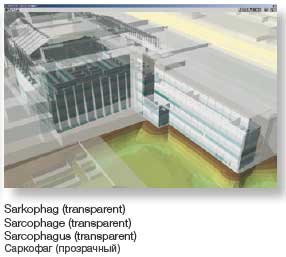
What's new and quite interesting here are recent ArcView GIS [Geographic Information System] and computer-generated 3D maps of the site, many which include environmental radiation level isosurfaces (example from the GRS/IRSN 2005 report shown).

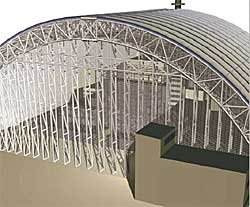
A computer rendering of Chernobyl Shelter 2, shown here, depicts the proposed new external containment structure for the hastily-constructed 1986 sarcophagus, now severely deteriorated by harsh weather and intense radiation.

According to the SIP [Shelter Implementation Plan], the goal of building the aluminum semicircular housing is "to safely confine the radioactive materials for at least 100 years and...to allow their retrieval from inside if need be as well as the dismantling of the old structure."

Archives: Chernobyl Reactor 4 "Radioactive Volcano"


[Originally Posted May 15, 2004] My search for information on Chernobyl has taken me to some very strange places.

This morning, I found this image on a fascinating Italian Chernobyl website, The Humus Project, or Progetto Humus, at http://www.progettohumus.it [the page this image appears on is here]. Look closely.

I can't verify its authenticity (unfortunately, many of the images lack captions or explanations) but it appears to be a shot of the glowing core of Chernobyl Reactor 4 shortly after the explosion. The timestamp on the image reads 01:23:59. But is it 1:23:59 AM on April 26th, 1986?

Thinkquest Library states that the containment lid of Reactor 4 blew off at 01:23:44 am, while the German 'Society for Plants and Reactor Safety', GRS (Gesellschaft für Anlagen und Reaktorsicherheit, in their technical report "The Accident and Safety of RBMK Reactors" [5Mb PDF file]) places the time of the explosion at:
01:24:00

Recording of the shift supervisor: "Strong impacts, the shutdown systems stop before reaching the lower end position ..." Reactor excursion with more than 100 times of the nominal power. Explosion and destruction of the reactor core. The upper plate of the reactor is hurled up, all pressure tubes break off. Core material and burninggraphite parts are ejected. The reactor is burning, further fires start in the surrounding. Massive release of radioactive fission products.
If this photo is genuine, then it would be the first time I've been able to track down an image of the reactor in the earliest stages of the accident. I have not yet found an image of this type anywhere in Chernobyl literature, either on video, in books or and other source. Where did this come from, considering that the former Soviet Union did not inform the outside world of the explosion until days later? Was there a camera trained on the reactor? Did the image come from a flight over the reactor later than the timestamp indicates?

Humus Project Chernobyl Video streams
Google Directory page for Science > Technology > Energy > Nuclear > Safety and Accidents > Chernobyl.
Belarus Guide on Chernobyl Information
Humus Project English version (Progetto Humus, Italy)

March 10, 2006

Upcoming World Conference in Belarus on "Chernobyl After 20 Years"

From the Bahrain News Agency:
Minsk, March. 10, (BNA)

A world conference will be held on April 19, in the capital city of Belarus, under the theme of "Chernobyl after 20 years: Urbanization strategy and Sustainable development of the Unfortunate Area." The conference which will mark the 20th anniversary of the disaster will be attended by representatives of 50 countries and 16 international organizations.

The Russian News Agency, Itar Tass, said today invitations for the conference was sent by Belarus President to Director of the International Atomic Energy Agency (IAEA), the World Health Organization (WHO) and UN Development Organization (UNDO). During the conference, Belarus, the most hit country, Russia and Ukraine will present reports on the efforts they had made to alleviate the disaster's effects.

February 28, 2006

Chernobyl Children's Project International's "20 Years, 20 Lives" Series

A little while back, I received an email from Kathy Ryan of the Chernobyl Children's Project International, with news about the organization's special web series, "20 Years, 20 Lives":
"...I've been reading your Radioactive blog with interest, and I wanted to call to your attention a series that we recently started running on our website. It is called "Chernobyl: 20 Years 20 Lives" and it is a series of eyewitness accounts in words and interviews of people whose lives continue to be affected by the Chernobyl nuclear disaster...."
Thank you for your message, Kathy - I'm very happy to pass on the word, and thank you for all the good work your organization provides to help those affected by the disaster.
Chernobyl – Twenty Years, Twenty Lives is EarthVision's photo journalistic journey through the countries of the Ukraine, Belarus, Russia, Latvia, Sweden, France, and UK. It follows twenty people in their daily lives nowadays and reflects on how they changed after the events of April 1986. The goal of the project is to learn from the history and look at the accident from the present perspective at different levels, both locally and globally. Almost 20 years after the Chernobyl disaster, controversy continues about the true effects of the disaster. Chernobyl Children's Project International believes that the story of Chernobyl can be best told through the eyes of the variety of people who have been affected by the disaster.
...
A photo exhibition with the twenty life stories will tour the world beginning at April 2006. EarthVision is currently seeking exhibition hosts. You can reach EarthVision and learn more about the project at 20lives.info.

December 08, 2005

Chernobyl News: Resettlement, More Tourism, and Removal of Nuclear Fuel from Closed Reactor Units

Crews have begun dismantling the remaining nuclear fuel stockpile from the closed reactors at Chernobyl, including the only recently-decommissioned Reactor 3 (the unit involved in the 1986 explosion was Reactor 4). From the Seattle Post-Intelligencer, via AP:
KIEV, Ukraine -- Experts have begun unloading radioactive fuel from one of the closed reactors at Ukraine's Chernobyl nuclear power plant, the plant said Tuesday.

Reactor No 3. - the last to continue operating - was closed for good in 2000, but it was never emptied of fuel. The remaining fuel in reactor No. 3 and reactor No. 1 made it impossible to start construction of a new shelter over the fourth reactor, destroyed in the 1986 explosion and fire that spewed radiation over much of northern Europe.

In an effort to prevent further radiation release, engineers hastily erected a concrete-and-steel shelter over the damaged reactor, but parts of it are crumbling, and a new shelter is needed. Originally officials had planned to unload the remaining fuel into a new storage depot, but plans for its construction were suspended until 2010. The plant's spokesman, speaking on customary condition of anonymity, said the fuel will instead be unloaded into a Soviet-era used fuel depot. Unloading the fuel, which began Monday, is necessary to make the plant entirely inoperative, Chernobyl staff said.
In other Chernobyl news, Pravda reports the Ukraine is seeking to boost national revenue by offering more tours of the ravaged Exclusion Zone to foreign travelers, and RIA Novosti News says Ukrainian president Viktor Yushchenko has instructed Kiev officials to begin legalizing the homes of squatters who have moved in the area without permission.

October 08, 2004

St. Petersburg: Report Says Renovation of Chernobyl-Type Reactor Rushed

From the St. Petersburg Times, disturbing news about an aging RBMK-1000 type reactor being renovated for reactivation:
Report Says Renovation of Chernobyl-Type Reactor Rushed
October 8, 2004
By Vladimir Kovalev
STAFF WRITER
A series of mishaps has occurred during the renovation of reactor No.1 at the Leningrad Nuclear Power Plant, or LAES, in Sosnovy Bor outside St. Petersburg because basic safety regulations were ignored, according to a new report.

Reactor No. 1 is the oldest of four reactors at the plant and its official working life has expired, but the Federal Nuclear Power Agency is seeking to extend it. It is an RBMK-1000 reactor, the same type that caused the Chernobyl disaster in 1986, and LAES management plan to restart it this fall.

Sergei Kharitonov, a former employee of the plant and now an environmental campaigner, wrote in the report that the safety systems for the reactors were installed in a rush, in some cases by unqualified workers, breaching standards on how the work should be done, the report said.

As a result, two workers died in the spring, including a 32-year-old construction worker who fell from the wall of bloc No.1 in April and a 42-year-old fitter was crushed while working on bloc No.2 in May.

"[The management] paid most of its attention to [staff] training for the launch of bloc No.1," Kharitonov quoted LAES management as saying in a statement on July 16. "The lectures were poorly attended ... Two lectures remain to be conducted. Such a situation is unacceptable, when the bloc [No.1] is about to launched, but employees are not ready for it."

August 18, 2004

Engineer Witnessed Chernobyl From Within - And Lives To Tell

From New Scientist: "Alexander Yuvchenko was on duty at Chernobyl's reactor number 4 the night it exploded on 26 April 1986. He is one of the few working there that night to have survived. He suffered serious burns and went through many operations to save his life, and he is still ill from the radiation. He recently broke his silence for a documentary to be shown on the Discovery Channel. Here he speaks to Michael Bond about what happened that night:"
To get a clearer idea of what had happened we walked outside. What we saw was terrifying. Everything that could be destroyed had been. The entire water coolant system was gone. The right-hand side of the reactor hall had been completely destroyed, and on the left the pipes were just hanging. That was when I realised that Khodemchuk was definitely dead. The place where I was told he'd been standing was in ruins. The huge turbines were still standing, but everything around them was rubble. He must have been buried under that.

From where I stood I could see a huge beam of projected light flooding up into infinity from the reactor. It was like a laser light, caused by the ionisation of the air. It was light-bluish, and it was very beautiful. I watched it for several seconds. If I'd stood there for just a few minutes I would probably have died on the spot because of gamma rays and neutrons and everything else that was spewing out. But Tregub yanked me around the corner to get me out the way. He was older and more experienced.
Zero Hour: Disaster at Chernobyl airs on the Discovery Channel UK.