Showing posts with label Cold War. Show all posts

November 26, 2013

Uranium Film Festival Comes to Navajo Nation Dec 2-4

The International Uranium Film Festival makes a stop at the Navajo Nation Museum in Window Rock, Arizona this December 2nd through the 4th, bringing three days of insightful documentaries that reveal stories of many First Nations and aboriginal peoples worldwide whose historical lands have been used for radioactive minerals mining and nuclear waste disposal - often with little regard for the health, safety, and security of the communities involved. The Southwestern United States was an epicenter of wartime and peacetime uranium mining from the Cold War onwards; the Navajo Nation only one of sadly many who have suffered its lasting ill consequences.
The [International Uranium Film Festival] is the world's only traveling film festival devoted to the entire Nuclear Fuel Chain, from uranium mining to uranium tailings and nuclear waste, from Hiroshima to Fukushima and Fallujah.

The festival will make its way from Albuquerque (Nov. 27-28) to Santa Fe (Nov. 30-Dec. 1), to Window Rock and finally to Washington D.C. and New York City in early 2014. The founder of the IUFF, Norbert G. Suchanek of Germany, will be present at each screening along with Executive Director Marcia Gomes de Oliveira of Brazil and various producers and directors of the films. Each screening is organized by a diverse group of volunteers to bring these films to the wide screen.

Because of the tremendous impact uranium mining has had on Diné peoples, while these films are playing in the theatre of the Navajo Nation Museum, there will be several organizations coming together on the side to dialogue about the uranium legacy issues still plaguing the Navajo Nation and the new uranium mining permit applications threatening nearby communities and Sacred Sites. Community groups, residents and allies will meet for the two and a half days at the museum and in the local area. Online video streaming will be available via ustream.com during selected hours of the event.
The film festival's schedule and more details are also available on their Facebook page.

May 31, 2013

Uranium Film Festival Rio de Janeiro Announces 2013's "Yellow Oscar"-Winning Films

While I haven't yet had the chance to attend one of the touring festivals since their start in 2011, as a former media person with a life-long fascination in all things nuclear, the international Uranium Film Festival holds a very special interest for me. This past Sunday, May 26th capped nine days of film and documentary showings in Rio with the "Yellow Oscar" awards, celebrating offerings of exceptional merit. From the Uranium Film Festival's "Art and Awareness" website section,
[The festival] was founded in 2011 in Santa Teresa, the famous artist quarter in the heart of Rio de Janeiro. The aim of the festival is to inform the public, from a neutral position, about nuclear power, uranium mining, nuclear weapons and the health effects of radioactivity. The horror of atomic bombs and those who suffered from them, and nuclear accidents like Chernobyl or Fukushima should never be forgotten - nor repeated. The correlation between nuclear energy and weapons must be openly discussed. The festival inspires discourse about the health and environmental risks of radioactive materials and waste. We seek to educate and activate the public on these issues. The dynamic media of film is an important tool to bring that information to a diverse international public.
Among this year's Yellow Oscar winners is Nuclear Savage: The Islands of Secret Project 4.1, a documentary by Adam Jonas Horowitz on the devastating effects of U.S. Cold-War nuclear testing on residents of the Marshall Islands, including government footage of nuclear tests and interviews with residents of nearby Rongelap Atoll,which was never evacuated before the March 1954 "Bravo" test - America's largest-ever atomic test explosion, a thousand times more powerful than Hiroshima.

Other winners this year include Atomic Ivan (Russia), for best feature fiction movie; Curiosity Kills (Estonia), for best short comedy; High Power (India), for best short documentary; Abita (Germany), for best animated film, and No to a Nuclear Jordan (Jordan), for the best student film.

Learn more about the Uranium Film Festival and upcoming events at uraniumfilmfestival.org.

April 08, 2013

"Exposure: Radiation Victims Speak Out" Web Series Reveals Personal Struggles, Triumphs

Over 20 years ago, the Hiroshima newspaper Chugoku Shimbun sent a team of reporters to 15 nations around the world to gather personal accounts of people affected by radiation - from reactor accidents, accidental contamination, to nuclear weapons manufacturing and testing. The interviews were initially published as a series of eight newspaper features titled "Sekai no Hibakusha," or "Hibakusha (figuratively, "atomic bomb survivors") Around the World." This monumental series won a Japan Newspaper Publishers and Editors Association award in 1990, and was subsequently published in book form the following year. Executive Director of the Chugoku Shimbun Yukio Ogata explains,
"Largely as a result of the articles' success in bringing the public's attention to the dangers of radiation, a number of victims of radioactive contamination from areas as far-flung as Chernobyl and Bikini Atoll were able to participate in the world convention held in Hiroshima by the International Physicians for the Prevention of Nuclear War in October 1989...[T]he convention heard details concerning the damage caused by nuclear testing in Kazakhstan, which until then had been shrouded in secrecy. In turn, this disclosure of widespread destruction of the environment prompted the Chugoku Shimbun to instigate the first-ever investigation of the testing area.

At the same time, the articles served to emphasize the role that Japan could play to help radiation victims around the world. The fact that the articles have prompted the exchange of information concerning the treatment of radiation victims in Japan to help those in a similar plight in other countries is a great source of satisfaction to us at the Chugoku Shimbun. We hope that, in the future, Japan will become known as an information center for radiation victims and the treatment of their illnesses."
In March 2013, the Hiroshima Peace Media Center re-released the entire series of 134 interviews free online as "EXPOSURE: Victims of Radiation Speak Out". From the English-language introduction by Dr. Robert Jay Lifton, Director of the Center on Violence and Human Survival at the CUNY John Jay College of Criminal Justice notes,
"There is compelling appropriateness in the project's being undertaken by concerned journalists from Hiroshima. From the time the bomb was dropped, the Chugoku Shimbun, as Hiroshima's leading newspaper, has been a prime source of information about the experiences and feelings of the people of that city over subsequent decades. Its editors and writers have taken on what I call a 'survivor mission' on behalf of the city's victims, a commitment to transforming the fear, conflict, and pain of the survivors into an active exploratory enterprise of profound significance.

Their contribution goes even beyond their descriptions of the human effects of radiation. In the way they have approached their study, they have demonstrated what I call a species mentality, a commitment that transcends immediate group or nationality and extends to all of humankind. They evoke in us a sense of shared fate, of universal susceptibility to a technology that knows no boundaries, geographical or temporal. We are all in this together, as potential victims and potential perpetrators as well.
Among the regions and incidents covered in these interviews are Chernobyl, the 1987 Goiânia Accident in Brazil, contamination from the Cold War weapons program at Semipalatinsk, Kazakhstan, and the Hanford Nuclear Reservation site in Washington State.

[Image courtesy Hiroshima Peace Media Center: "The mushroom cloud as seen from Kure, approximately 18 kilometers southeast of Hiroshima. This photo was taken by Masami Oki about 40 minutes after the bomb exploded."]

More:

June 08, 2012

RadioActive! Classic: Chernobyl Requiem - May 2004

[Originally published May 4, 2004. I'm working on a follow-up version that will examine how things have changed in the intervening years. - LR]

I'm still not certain what triggered it, but this weekend I started thinking about the Chernobyl disaster. True, it's a strange topic to suddenly become interested in, and I can't pinpoint any precipitating cause, such as a news story or random overheard conversation.

Considering that I had a major obsession with nuclear war back in the mid-1980's, I've been rather nuke-phobia-free for the last twenty years or so. The truth is, when Chernobyl's Reactor 4 exploded on April 26th, 1986, I don't remember being horribly concerned or glued to the television for news on the event. This can probably be explained by the fact that I was 18 at the time, and current events were rarely the stuff of daily obsession for me then. I think the zenith of my nuclear paranoia came in 1984 (Coincidence? We think not!), when my high school classes were periodically interrupted with fallout drills and regular lessons on Civil Defense Emergency evacuation procedure.

You see, I lived in Plattsburgh, New York back then - home to Plattsburgh Air Force Base, which was a prominent Northeast strategic ICBM target. What we were all told back then was basically that when the Russkies finally pressed the Big Red Button (of course, it would always be the Russkies pushing the button first), our immediate response should be to duck down under a table or desk, away from glass windows, place our heads protectively between our knees, and kiss our arses goodbye.

Between Ronald Reagan's regularly televised polemics, the "star wars" defense initiative, the Plattsburgh Yellow Pages' obligatory section on Civil Defense evacuation procedures (complete with maps where we should assemble with a change of warm clothing, canned food, jugs of clean water and prescription medications within ten minutes from when we first heard the alarm sirens, preparing to be bussed to safe locations before the Big One hit PAFB in 30 minutes - that's how long it would take the Russkies' ICBM's to strike our little air base) and songs like '99 Red Balloons' by Nena, 'Distant Early Warning' by Rush, 'Dancing With Tears In Our Eyes' by Ultravox (and many others) blaring sweaty repressed fear with a synth-and-guitar backbeat, I had recurring nightmares about nuclear war at least once a week back then.

Every time I heard a fire station call siren, I thought it might be The Big One. It got to the point that when I saw a flash of lightning to the eastern horizon, for a moment my heart skipped and I wondered whether my 30-minute timer had begun.

Sounds crazy, but those were crazy times. Who new that less than two years later, hell would break loose in the Ukraine, with a near-unstoppable radioactive fire spewing toxins into the Northern hemisphere upper atmosphere for nearly two weeks?

Compounding the Chernobyl event's mystery was the Soviet government's complete media silence about the accident for two days, only admitting to the disaster after a Swedish ambassador implored Moscow for answers why incredibly high levels of radiation were being detected in the Scandinavian nation for no apparent reason. Soon images of the reactor inferno reached the outside world, with accounts of brave, desperate virtually unprotected firefighters and helicopter pilots on suicide missions, struggling to put down the graphite moderator fire; the coverage near operatic in its dangerous grandeur and human pathos, a Götterdammerung of man against the mighty Atom unchained.

This past Sunday I heard a dark, minor-key Russian choral hymn on WBEZ, a Chicago classical music station, and in my mind I played over the images of the Chernobyl cataclysm I'd recently seen and read: the juxtaposition made me well up with emotion. Now, for the past few days' I've been researching the entire Chernobyl incident - historical footage and media coverage, and regular updates prepared by regulatory agencies and multinational consortiums, including those who plan to clean up the entombed reactor and rebuild a more permanent protective shield than the hastily-constructed, crumbling Sarcophagus.

I've discovered that the Chernobyl story is far from over: the monster only sleeps. Authorities in the former Soviet Union publicly decried their population's fear of Chernobyl's fallout as "radiophobia," a mass hysteria with no basis in fact. Unfortunately, when authorities are less than candid about the facts, people will try to read between the lines and fill in the blanks, often creating mass panic. Today, a number of nations are scrambling to raise funds to finally contain and clean up the reactor ruin, to dissect its poisonous innards before it wakes, stirred up by seismic activity, weathering, or other events. This project is called the Shelter Implementation Plan, or SIP [PDF file].

Perhaps the recent look back at Chernobyl is no coincidence. Here in Chicago's Hyde Park, just a few yards from where I work, is a large brass Henry Moore sculpture that looks vaguely like a deformed hollow skull, or a mushroom cloud. It stands at the former site of the University of Chicago's Stagg Field, where on December 2, 1942, a researcher named Enrico Fermi created the world's first controlled self-sustaining nuclear reaction. The sculpture is called "Nuclear Energy", and it marks the place where the power of the atom first emerged in the world of man; if not for this event that took place near where I pass every day, there would have been no Hiroshima, no Nagasaki, no Three Mile Island, and no Chernobyl. As Prometheus stole fire from the gods, so Fermi stole the fire of the atomic pile: nuclear energy may certainly have brought some benefits to humankind, but at a rather steep price with compounded interest.

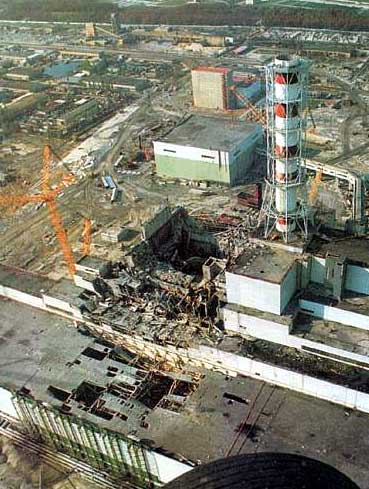
NOTE: The photo at the top of this post is a rare excellent shot of the destroyed reactor after the fire was put out - but before the Sarcophagus was constructed. I found it on the Chernobyl Tour site, where you can apparently book a tour of the area, including stops near the reactor and the neighboring ghost town of Pripyat. Tourists get special disposable clothing and respirators for the trip, and a complimentary computerized souvenir dosimeter reading (unfortunately, I'm not joking). Sorry, no photos allowed by Ukrainian law, which would explain the relative dearth of good images of the accident site available. However, some photos do appear on the Web, mostly from Ukrainian residents who visit the area and some from foreign press visits, which I'll be offering links to in the forthcoming special farkleberries feature on the Chernobyl accident anniversary. April 26th, 1986.

The photoessay site "Ghost Town", created by a young Ukrainian woman named Elena, has received over 2.5 million hits as of this writing; you'll find dozens of startling, one-of-a-kind images of the Chernobyl region accompanied by Elena's account of her visit. While access is strictly limited, Elena states that her father works for the government, and was able to arrange a permit for her motorcycle visit. Thank you, Walt, for this excellent link.

18 years is nothing in the life of a plutonium atom.

May 24, 2012

Nevada's Historic BREN Atomic Test Tower Demolished

[Image and YouTube video from the NNSA. Thanks to James Stover (tweeting at @JamesStoverAPR) for the story!]

Yesterday, in the Nevada desert, demolition crews from New York and Maryland felled a legendary piece of America's atomic history.

At 1,527 feet tall, the former Nevada Test Site's BREN tower was the "tallest free-standing structure west of the Mississippi River," and also the "tallest structure of its kind ever demolished," according to the National Nuclear Safety Administration. Originally built in 1962 in Yucca Flats, from fifty-one 30-foot sections of steel and two and a half miles of steel cable, the tower was moved to its latest location in Jackass Flats in 1966 after the Nuclear Test Ban Treaty banned open-air nuclear testing.
From CNN: The tower stood taller than the Empire State Building (1,454 feet) and the Eiffel Tower (1,063 feet). It was also taller than the iconic Stratosphere (1,148 feet) on the Las Vegas strip...[T]he BREN Tower took its name from the nuclear radiation experiment for which it was built: Bare Reactor Experiment - Nevada. BREN Tower was designed to provide a way for scientists to accurately estimate radiation doses received by survivors of the atomic bombs detonated over the Japanese cities of Hiroshima and Nagasaki during World War II. The tower stood 1,527 feet tall because that was the height at which "Little Boy," the first atomic bomb used in warfare, was detonated over Hiroshima on August 6, 1945.
At one time, a mock Japanese village was built near the tower's base to give researchers better modeling of the effects of a nuclear explosion on inhabited areas. Officials from the NNSA said the tower, which stopped being used in 1999, was too costly to maintain and restore, and posed a hazard to passing aircraft.

May 04, 2004

Nuclear TV: Atomic Café

Last Friday I located a VHS copy of Atomic Café (1982, directed by Jayne Loader and Kevin Rafferty) at the Harold Washington library, a feature many call the "atomic version of Reefer Madness". The film compiles a stunning array of archival footage segments - ranging from military training films and Civil Defense tutorials, to 4-H meetings and scenes from atomic bomb testing at the Trinity site, the Bikini Atoll, and Marshall Islands.

Between snippets of the Julius and Ethel Rosenberg executions, the McCarthy Hearings and hawk Congressmen advocating preemptive military strikes on China during the Korea War, the viewer may come away relieved (and surprised) that the world did in fact manage to survive this utterly hell-bound period of history. In summary, Atomic Café is an engrossing (if somewhat disorganized) depiction of the nature of America's postwar double-edged obsession with the atom, and fortunately it's not out of print, but available for sale in both DVD and VHS formats. Frankly, "surreal" is a bit mild a term to describe views of children riding tricycles in homemade "radiation suits," still-twitching hogs burnt alive to a crisp after being exposed to nuclear blast testing, and Army films designed to reassure servicemembers (and the public) that radiation sickness is a mild, temporary and harmless side effect:
(A young, dark-haired man gazes worriedly into a mirror with a full head of hair, fearful of losing his looks to radiation sickness. As the narrator sanctimoniously reassures him, the man's reflection fades into a healthy example of "horseshoe" male-pattern baldness, supposedly from nuclear fallout)

"they may call you 'baldy' or 'chrome dome' for a while, but in no time you'll be back to your old self again!"

(Bald man dissolves back into his smiling fully-haired self)
No mention of hair falling out by the fistful, vomiting and diarrhea, blistered peeling skin and gangrenous sores anywhere. How did the public swallow all this hook line and sinker? I believe the reason is that the vast majority of audiences didn't know much better back then, and before Watergate and the Kennedy assassination Americans were far more trusting of the government's declarations at face value. Atomic energy promised not only victory over "the Hun," but domestic energy production so cheap it couldn't be metered. One interview with a Cold War-era man shown in Atomic Café underscores the public's general misapprehension of the Nuclear Threat:
Interviewer: "Sir, what do you plan to do, if upon emerging from your family's fallout shelter, you discover that only 5 to 10 percent of the people have survived the attack?"

Man: "Well, I guess that would be fine - with fewer mouths to feed, there would be a lot more to go around for the folks that are left!"
Today, we have easy access to images of the horrific damage radiation can inflict; during wartime, no doubt the government thought better than to alarm a still-innocent populace with the grand scope of the Bomb's potential destruction. "Duck and Cover" made a fine catchy bromide for the masses. Let them build shelters and fishing-sinker-filled "radiation suits"; what they don't know can't hurt them.

Archive.org (part of Wayback Project) has a great collection of downloadable films and videos from our nation's nuclear past, such as Radiation Safety in Nuclear Energy Explorations. You can even download and watch the entire "Duck and Cover" short film from Archive.org's Prelinger Archives Collection; it's one of their most-viewed features.

Atomic Age Artifacts at Oak Ridge's Historical Instrumentation Museum

There's some artifacts from the Atomic Age at the Oak Ridge Associated Universities Historical Instrumentation Museum (http://www.orau.org).

Many of the items on display (part of the Professional Training Program at Oak Ridge Laboratory in Tennessee (865-576-3576)) show just how far we've come from viewing radation simply as a beneficent modern boon...get your "glow" on with these artifacts from the Radiant Era:

The strange origins of the modern trefoil radiation symbol.

Who says radioactivity can't be fun and games? Atomic Toys! Including the Atomic Energy Lab for youngsters, and a the Con-Cor™ toy nuclear power plant for your scale model train layout - based on Three Mile Island!

The Nu-Klear Fallout Detector™ - no Cold War era family should have gone without this device (which operates on the principle that ionizing radiation will discharge static electricity-charged items), used by "leaving the detector just outside the fallout shelter exit for five minutes. If the beads have not all fallen to the bottom during that time, "you may risk exposure for a few minutes if you are faced with an emergency that cannot wait another day."

Homer Simpson would be proud: there once was a time when "Radium" meant quality...these days, good luck trying to sell 1940's-vintage Radium Condoms™, Radium "Male Pouches," or Radium Beer™.

Get really, really clean...with Radioactive Soap.

To commemorate Madame Curie's glowing discovery, Broadway composer Jean Schwartz wrote "The Radium Dance" for the 1904 smash hit, Piff! Paff! Pouf!

Irradiated Golf Balls may not help your handicap, but they'll get lots of curious looks.

Chernobyl Requiem, Part 1

I'm still not certain what triggered it, but this weekend I started thinking about the Chernobyl disaster. True, it's a strange topic to suddenly become interested in, and I can't pinpoint any precipitating cause, such as a news story or random overheard conversation.

Considering that I had a major obsession with nuclear war back in the mid-1980's, I've been rather nuke-phobia-free for the last twenty years or so. The truth is, when Chernobyl's Reactor 4 exploded on April 26th, 1986, I don't remember being horribly concerned or glued to the television for news on the event. This can probably be explained by the fact that I was 18 at the time, and current events were rarely the stuff of daily obsession for me then. I think the zenith of my nuclear paranoia came in 1984 (Coincidence? We think not!), when my high school classes were periodically interrupted with fallout drills and regular lessons on Civil Defense Emergency evacuation procedure.

You see, I lived in Plattsburgh, New York back then - home to Plattsburgh Air Force Base, which was a prominent Northeast strategic ICBM target. What we were all told back then was basically that when the Russkies finally pressed the Big Red Button (of course, it would always be the Russkies pushing the button first), our immediate response should be to duck down under a table or desk, away from glass windows, place our heads protectively between our knees, and kiss our arses goodbye.

Between Ronald Reagan's regularly televised polemics, the "star wars" defense initiative, the Plattsburgh Yellow Pages' obligatory section on Civil Defense evacuation procedures (complete with maps where we should assemble with a change of warm clothing, canned food, jugs of clean water and prescription medications within ten minutes from when we first heard the alarm sirens, preparing to be bussed to safe locations before the Big One hit PAFB in 30 minutes - that's how long it would take the Russkies' ICBM's to strike our little air base) and songs like '99 Red Balloons' by Nena, 'Distant Early Warning' by Rush, 'Dancing With Tears In Our Eyes' by Ultravox (and many others) blaring sweaty repressed fear with a synth-and-guitar backbeat, I had recurring nightmares about nuclear war at least once a week back then.

Every time I heard a fire station call siren, I thought it might be The Big One. It got to the point that when I saw a flash of lightning to the eastern horizon, for a moment my heart skipped and I wondered whether my 30-minute timer had begun.

Sounds crazy, but those were crazy times. Who new that less than two years later, hell would break loose in the Ukraine, with a near-unstoppable radioactive fire spewing toxins into the Northern hemisphere upper atmosphere for nearly two weeks?

Compounding the Chernobyl event's mystery was the Soviet government's complete media silence about the accident for two days, only admitting to the disaster after a Swedish ambassador implored Moscow for answers why incredibly high levels of radiation were being detected in the Scandinavian nation for no apparent reason. Soon images of the reactor inferno reached the outside world, with accounts of brave, desperate virtually unprotected firefighters and helicopter pilots on suicide missions, struggling to put down the graphite moderator fire; the coverage near operatic in its dangerous grandeur and human pathos, a Götterdammerung of man against the mighty Atom unchained.

This past Sunday I heard a dark, minor-key Russian choral hymn on WBEZ, a Chicago classical music station, and in my mind I played over the images of the Chernobyl cataclysm I'd recently seen and read: the juxtaposition made me well up with emotion. Now, for the past few days' I've been researching the entire Chernobyl incident - historical footage and media coverage, and regular updates prepared by regulatory agencies and multinational consortiums, including those who plan to clean up the entombed reactor and rebuild a more permanent protective shield than the hastily-constructed, crumbling Sarcophagus.

I've discovered that the Chernobyl story is far from over: the monster only sleeps. Authorities in the former Soviet Union publicly decried their population's fear of Chernobyl's fallout as "radiophobia," a mass hysteria with no basis in fact. Unfortunately, when authorities are less than candid about the facts, people will try to read between the lines and fill in the blanks, often creating mass panic. Today, a number of nations are scrambling to raise funds to finally contain and clean up the reactor ruin, to dissect its poisonous innards before it wakes, stirred up by seismic activity, weathering, or other events. This project is called the Shelter Implementation Plan, or SIP [PDF file].

Perhaps the recent look back at Chernobyl is no coincidence. Here in Chicago's Hyde Park, just a few yards from where I work, is a large brass Henry Moore sculpture that looks vaguely like a deformed hollow skull, or a mushroom cloud. It stands at the former site of the University of Chicago's Stagg Field, where on December 2, 1942, a researcher named Enrico Fermi created the world's first controlled self-sustaining nuclear reaction. The sculpture is called "Nuclear Energy", and it marks the place where the power of the atom first emerged in the world of man; if not for this event that took place near where I pass every day, there would have been no Hiroshima, no Nagasaki, no Three Mile Island, and no Chernobyl. As Prometheus stole fire from the gods, so Fermi stole the fire of the atomic pile: nuclear energy may certainly have brought some benefits to humankind, but at a rather steep price with compounded interest.

NOTE: The photo at the top of this post is a rare excellent shot of the destroyed reactor after the fire was put out - but before the Sarcophagus was constructed. I found it on the Chernobyl Tour site, where you can apparently book a tour of the area, including stops near the reactor and the neighboring ghost town of Pripyat. Tourists get special disposable clothing and respirators for the trip, and a complimentary computerized souvenir dosimeter reading (unfortunately, I'm not joking). Sorry, no photos allowed by Ukrainian law, which would explain the relative dearth of good images of the accident site available. However, some photos do appear on the Web, mostly from Ukrainian residents who visit the area and some from foreign press visits, which I'll be offering links to in the forthcoming special farkleberries feature on the Chernobyl accident anniversary. April 26th, 1986.

The photoessay site "Ghost Town", created by a young Ukrainian woman named Elena, has received over 2.5 million hits as of this writing; you'll find dozens of startling, one-of-a-kind images of the Chernobyl region accompanied by Elena's account of her visit. While access is strictly limited, Elena states that her father works for the government, and was able to arrange a permit for her motorcycle visit. Thank you, Walt, for this excellent link.

18 years is nothing in the life of a plutonium atom.