Showing posts with label containment. Show all posts

March 26, 2013

Chernobyl Database: A New, Useful Research Tool

While having much of the Internet at one's disposal through search engines is a wonderful thing - especially when you know what you're looking for - specialized blogs like the new Chernobyl Database (launched February 2013) also serve a vital purpose: they can help point you in the direction of new research studies and findings you may have been unaware of.

Chernobyl Database, which I believe is based in Japan, focuses fairly narrowly on posting papers studying the effects of radiation and radioactive contamination on the environment and health, but it also ventures deeply by including links to research going back several decades. Entries are primarily in English, with separate categories for articles published in Japanese and Russian. I think you'll find it a valuable resource.

November 30, 2012

Chernobyl's New Safe Confinement Rises: The First Stage

After nearly two decades of administrative, political, and financial setbacks, major progress is being made now at the New Safe Confinement. Having been previously called "Ukritye" and the "Shelter Implementation Plan" over the years, the secure NSC outer shell being built over the decaying Chernobyl Sarcophagus will allow Reactor 4 to finally be safely dismantled with greatly reduced risk to the environment.

In the clip below, Vince Novak, the EBRD [European Bank for Reconstruction and Development]'s Director of Nuclear Safety discusses the construction progress and the NSC's benefits.


This video (:35) shows a time-lapse version of the first NSC section's raising.

June 11, 2012

"Lessons Learned from 'Lessons Learned': The Evolution of Nuclear Power Safety After Accidents and Near-Accidents" (AAAS monograph, 2012)

Continuing our theme of our evolving understanding of nuclear power safety, I'd like to highlight an excellent - and timely - paper just released by the American Academy of Arts and Sciences, "Lessons Learned from 'Lessons Learned': The Evolution of Nuclear Power Safety after Accidents and Near-Accidents," by Edward D. Blandford and Michael M. May. From the preface:
"As countries struggle to meet the electricity demands of their growing populations while also reducing their carbon footprints, many have turned to nuclear energy. The U.S. nuclear energy program may not increase significantly in the coming decades, but other countries, including many developing countries, have plans for rapid expansion. Even after the recent accident at the Fukushima Daiichi Nuclear Power Plant in Japan, the global trend toward expansion of nuclear energy has continued.

While serious accidents like Fukushima, Three Mile Island, and Chernobyl can provide invaluable lessons, the nuclear industry, nuclear regulators, and the research community must study minor incidents and near-accidents as well. These experiences often reveal not only how to decrease the likelihood that the same mistakes will occur, but also how to avoid larger accidents that may be foreshadowed in earlier, smaller incidents.

In this paper, Edward Blandford and Michael May enumerate the lessons from nuclear accidents and incidents, asking whether the nuclear energy community has indeed learned from those lessons. The authors argue that stakeholders must commit to ongoing improvement of their protocols and standards. Each nuclear incident—no matter its size—underlines the importance of pursuing high standards of safety, security, and proliferation resistance."
One standout key finding in "Lessons Learned..." is on page 23, in Table 1, "Main Sources of Electricity in the World and Their Morbidity and Greenhouse Gas Emissions Per Unit of Electricity Produced." The authors find that while nuclear energy is the fourth most prevalent form of electricity generation worldwide (at 14% of global usage), it is associated with the lowest number of deaths per terawatt hour (0.04). The least common form of generation, wind power (< 1% of global usage), somewhat surprisingly has a morbidity rate of 0.15 deaths per terawatt hour, but I suspect many of these might be a result of accidents involving installation or maintenance of the wind turbines, rather than the operating process itself.

If you're pressed for time, the paper's executive summary provides an informative primer on its conclusions and policy recommendations for the industry. The paper is available as a free PDF download as part of the AAAS' Occasional Papers series at http://www.amacad.org/publications/lessonsLearned.aspx, or as hard copy for a nominal fee from the AAAS.

April 28, 2012

Atomic Age II Fukushima Symposium, May 5th, 2012

RadioActive! readers near Chicago: the University of Chicago, the birthplace of the first controlled nuclear chain reaction, hosts Atomic Age Symposium II - Fukushima, this Saturday, May 5th.
[K]eynote speakers are Hiroaki Koide of the Kyoto University Reactor Research Institute, who has been speaking out against nuclear power for over 40 years; and Ruiko Muto, an anti-nuclear activist based in Fukushima and a member of a citizens’ group, Hairo [Reactor Decommission] Action Fukushima. Robert Rosner, Astronomy & Astrophysics & Physics, University of Chicago (former Director of the Argonne National Laboratory) will share his stance on nuclear energy via a videotaped message. Ruiko Muto’s speech will be followed by Bobbie Paul, Executive Director of Georgia WAND—Women’s Action for New Directions, Jeffrey Patterson (MD, Board Member and Past President of Physicians for Social Responsibility), and Dean Wilkie, a retired nuclear plant operator and manager who, with Nancy Foust, an online media expert, has collaborated on the Simply Info website to provide detailed information about Fukushima.
This will be an all-day symposium investigating the multiple dimensions of the ongoing Fukushima nuclear disaster through discussion by experts from Japan and the US, Saturday, May 5, 2012: 8:45am–6:00pm. This event is free and open to the public. Continental breakfast and lunch will be provided. For full information and details, visit http://lucian.uchicago.edu/blogs/atomicage/aboutsymposium/ or call 773-702-8647.

April 18, 2006

2005 Report: Safety State of the (Chernobyl) Sarcophagus

There is a new 2005 "Safety State of the Sarcophagus" report available online (9.7Mb PDF) from [Gesellschaft für Anlagen und Reaktorsicherheit] GRS/IRSN [Institut de Radioprotection et de Sûreté Nucleaire], the French-German Initiative for Chernobyl.

The free 70-page color booklet contains narrative in French, German, English and Russian; along with photos of the damaged reactor and the surrounding area, detailed accounts of the damage and radiation released in the 1986 accident, and current plans for abating and controlling the deterioration of the current "shell" surrounding Reactor 4.

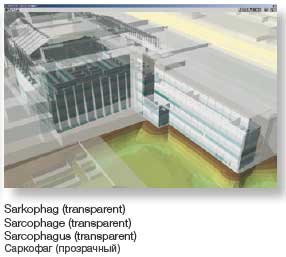
What's new and quite interesting here are recent ArcView GIS [Geographic Information System] and computer-generated 3D maps of the site, many which include environmental radiation level isosurfaces (example from the GRS/IRSN 2005 report shown).

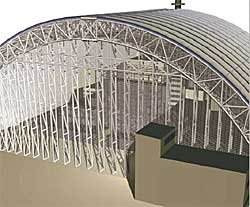
A computer rendering of Chernobyl Shelter 2, shown here, depicts the proposed new external containment structure for the hastily-constructed 1986 sarcophagus, now severely deteriorated by harsh weather and intense radiation.

According to the SIP [Shelter Implementation Plan], the goal of building the aluminum semicircular housing is "to safely confine the radioactive materials for at least 100 years and...to allow their retrieval from inside if need be as well as the dismantling of the old structure."